
Our Lady of Gietrzwałd
- Mary Prays

- May 13
- 6 min read
Gietrzwałd, Poland · June 27 – September 16, 1877

TLDR
She appeared over one hundred and sixty times to two girls preparing for First Communion in a region of Poland where the Polish language had been banned by the Prussian government. She spoke to the children in Polish, the forbidden tongue, and her core message was the same she has given everywhere: "Pray the Rosary zealously!" One hundred years later, Cardinal Karol Wojtyła presided over the formal approval of the apparitions, and one year after that he became the first Polish pope.
Year | 1877 |
Location | Gietrzwałd, Poland |
Visionary | Justyna Szafryńska & Barbara Samulowska |
Apparitions | 160+ |
Church Status | Approved by Holy See (1977); Cardinal Wojtyła presided |
Key Message |
Spoke in banned Polish language. Future Pope John Paul II approved. |
The World She Entered
Poland did not exist.
Not on any map, not in any government, not in any official document. Since 1795, the nation had been carved apart and divided among three empires: Russia, Prussia, and Austria. By 1877, the people of Poland had been living without a country for over eighty years.
In the region of Warmia, in what is now northeastern Poland, the situation was especially suffocating. The area was under Prussian rule, and Chancellor Otto von Bismarck had launched the Kulturkampf, a systematic campaign to crush Catholic influence. Catholic priests were expelled. Religious orders were dissolved. And in 1873, the Polish language was banned in all schools. Children were forced to learn in German. Polish identity, Polish culture, and Polish faith were being slowly strangled.
The people of Gietrzwałd, a small village twenty kilometers from Olsztyn, had almost nothing left. Their country was gone. Their language was forbidden. Their priests were being taken away. And yet they kept praying. They kept going to Mass. They kept teaching their children the faith in whispers and in secret.
And then, in the summer of 1877, heaven spoke to them. In Polish.
To Whom She Appeared
They were two girls preparing for their First Holy Communion.
Justyna Szafryńska was thirteen. Barbara Samulowska was twelve. They were from families in and around Gietrzwałd, ordinary village girls with no special distinction, studying their catechism under the guidance of their parish priest, Father Augustyn Weichsel.
They were not mystics. They were not looking for visions. They were children of a persecuted people, learning their prayers and preparing their hearts to receive the Eucharist for the first time.
How She Appeared
On the evening of Wednesday, June 27, 1877, Justyna was walking home from church with her mother. She had just passed her catechism exam. As the Angelus bells began to ring and she prayed the familiar words, she looked toward a maple tree near the church and saw something that stopped her in her tracks.
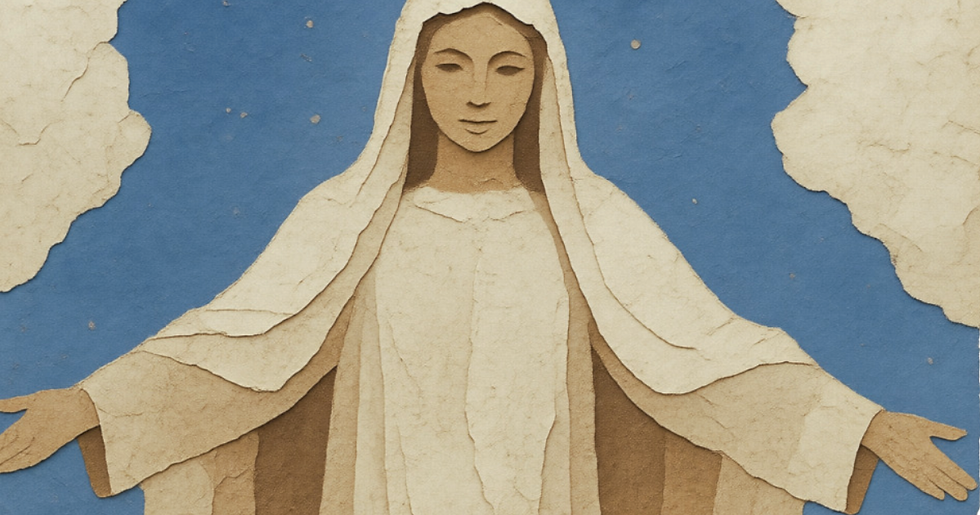
A beautiful woman in a white dress and blue veil, her feet resting on a cloud, a crown of twelve stars around her head. Between two withered boughs of the old maple tree, light was pouring out of heaven, and in the center of that light was the Blessed Virgin Mary.
The next day, June 28, Justyna returned to the same spot, this time with her friend Barbara. Both girls saw the Lady. She was seated on a throne, holding the Child Jesus on her left side. The Infant held a brilliant golden ball topped with a small cross. Angels surrounded them, and the angels were crowning Mary as the children watched.
It was the first of over one hundred and sixty apparitions that would continue through the summer and into September. Our Lady appeared to the girls at the hour of the Angelus, evening after evening, while crowds grew from curious neighbors to hundreds of thousands of pilgrims from across the partitioned lands of Poland.
The girls were questioned separately by priests, by doctors, by skeptics. Their accounts were consistent every time. They could not have coordinated their answers. They described what they saw and heard with the plainness and certainty that only children have.
What She Said
Our Lady spoke to the children in Polish.
In a region where their language had been banned, where speaking Polish in a classroom could get a child punished, the Queen of Heaven opened her mouth and spoke the forbidden tongue. That alone was a message before she said a single word. She was telling an entire people: your language is sacred, your identity is not forgotten, and heaven speaks your mother tongue.
When Justyna asked what Our Lady desired, the answer was the same one she has given at every apparition across the centuries:
"I desire that you pray the Rosary every day."
When Justyna asked, "Who are You?" on the day she and the other children received their
First Holy Communion, Our Lady answered:
"I am the Most Holy Virgin Mary, Immaculately Conceived."
The same title she had given at Lourdes nineteen years earlier, now spoken again, in Polish, to children in a land where the faith was under siege.
When the children asked whether the sick who came to Gietrzwałd would be healed, Our Lady responded with a promise:
"A miracle will happen, and after that the sick will be healed."
She asked for a chapel to be built at the site with a statue of the Immaculate Conception.
She asked for penance and conversion. And she gave the people of Warmia a promise that must have sounded almost impossible in 1877: that the persecution of the Church would end and the faith would be free again.
On September 16, 1877, the last day of the apparitions, at five o'clock in the evening, Our Lady blessed her own image in the small chapel, then blessed all the people who had gathered and all people everywhere. And her final words were the same as her first, spoken with a mother's gentle insistence:
"Pray the Rosary zealously!"
The Heart of Her Message
What happened at Gietrzwałd is what happens when a Mother comes to a people who have been told they are nothing and reminds them who they are.
She spoke their language when no one else would. She called herself the Immaculate Conception in Polish when Polish was forbidden. She asked for the Rosary, the prayer that has always been the weapon of the poor and the persecuted, the prayer you can say without a church, without a priest, without anything but your fingers and your faith. And she promised that the persecution would end.
It did. Not immediately, but it ended. And the faith she came to strengthen never broke, not under Bismarck, not under the Nazis, not under forty-five years of communist rule. Poland held on to the Rosary and the Rosary held on to Poland.
During the apparitions, the village of Gietrzwałd was visited by several hundred thousand pilgrims, an astonishing number for a tiny village in a suppressed nation. Healings were reported. Conversions multiplied. The local spring, which Our Lady blessed on the final day of the apparitions, was regarded as a source of healing, and pilgrims came from across the partitioned territories to drink from it.
The parish priest, Father Augustyn Weichsel, was one of the earliest and most careful advocates of the apparitions. He investigated the children thoroughly, questioned them separately, and found their testimony credible. He was later declared Blessed by the Church.
In 1977, one hundred years after the apparitions, Cardinal Karol Wojtyła presided over the formal approval of the apparitions by the Holy See. One year later, he became Pope John Paul II. The first Polish pope, approving the apparition where the Mother of God spoke Polish to a people who had been forbidden to speak their own language. The symmetry of providence is breathtaking.
In 1970, Pope Paul VI elevated the church at Gietrzwałd to the dignity of a minor basilica. Today, nearly a million pilgrims visit the shrine each year. A cross was carved from the wood of the maple tree where Our Lady appeared. The miraculous painting of Mary and the Child Jesus, first mentioned in 1505 and crowned in 1717, still hangs in the basilica.
Our Lady of Gietrzwałd is sometimes called the Polish Lourdes, and the comparison holds in more ways than one. At Lourdes, she appeared to a girl who could barely speak French and called herself the Immaculate Conception. At Gietrzwałd, she appeared to girls who were being told their language didn't matter and spoke it anyway. At both places, she asked for the same thing: the Rosary. At both places, a spring became a source of healing. And at both places, she chose the small, the poor, and the overlooked to carry her message to the world.
She came to a people who had lost their country and told them they had not lost their Mother. That is the message of Gietrzwałd, and it has never stopped being true.
Sources and Further Reading
The details of the Gietrzwałd apparitions are drawn from the testimonies of Justyna Szafryńska and Barbara Samulowska as recorded during the parish investigation led by Father Augustyn Weichsel and the subsequent diocesan inquiry. The apparitions were formally approved by the Holy See in 1977, with Cardinal Karol Wojtyła presiding. All excerpts of Our Lady's words are from the children's recorded testimony.
For those who want to go deeper:
Gietrzwałd Apparitions · Official Shrine Resource (English)
Our Lady of Gietrzwałd: Poland's Only Approved Marian Appearance · Aleteia
40 Years Before Fatima, Our Lady Appeared in Poland · National Catholic Register
Gietrzwałd (Poland) 1877 · MaryPages
Our Lady of Gietrzwałd, Poland, 1877 · Divine Mysteries and Miracles


Comments