
Our Lady of Lourdes

Massabielle, France · February 11 – July 16, 1858

TLDR
She appeared eighteen times to fourteen-year-old Bernadette Soubirous in a grotto near a garbage dump, identified herself as "I am the Immaculate Conception," and revealed a spring that still flows today and has produced seventy-two verified miraculous healings. Five million pilgrims visit Lourdes every year, making it one of the most visited Marian shrines in the world.
Year | 1858 |
Location | Lourdes, France |
Visionary | St. Bernadette Soubirous |
Apparitions | 18 |
Church Status | Fully approved (1862) |
Key Message |
Spring still flows. 72+ verified healings. 5 million pilgrims annually. |
The World She Entered
By the middle of the 1800s, Europe was changing fast and faith was losing ground.
The Enlightenment had swept through France for over a century, and with it came a growing conviction that miracles were impossible, that religion was superstition, and that science had made God unnecessary. Rationalism was the spirit of the age. The Church was under pressure. And in the small mountain towns of the Pyrenees, far from the intellectual debates of Paris, ordinary people were simply trying to survive.
Lourdes was one of those towns. Poor, rural, and largely forgotten. And in the poorest corner of that poor town lived a family so destitute that their home was an abandoned jail cell. The locals called it le cachot, the dungeon.
Just four years earlier, on December 8, 1854, Pope Pius IX had proclaimed the dogma of the Immaculate Conception, declaring that the Virgin Mary was preserved from original sin from the moment of her conception. It was a bold declaration in a world that was growing hostile to such things.
Heaven was about to confirm it in a way no one expected. Not through a theologian or a bishop, but through a girl who could barely read.
To Whom She Appeared
Her name was Bernadette Soubirous. She was fourteen years old, the eldest of nine children, many of whom had died. Her father, François, was a miller who had lost his mill and fallen into poverty. Her mother, Louise, struggled to feed the family. Bernadette herself had been sickly since childhood, weakened by cholera and plagued by severe asthma.
She spoke Occitan, the local dialect of the Pyrenees, not French. She had almost no formal education and could barely write. She didn't know her catechism well. By every measure the world uses to judge a person's importance, Bernadette Soubirous had none.
And yet she was the one heaven chose.
How She Appeared
On the morning of February 11, 1858, Bernadette went out with her sister and a friend to gather firewood along the river near the grotto of Massabielle. It was a cold day. Her sister and friend waded across a stream, but Bernadette, afraid of an asthma attack from the cold water, stayed behind.
And then, in her own words:
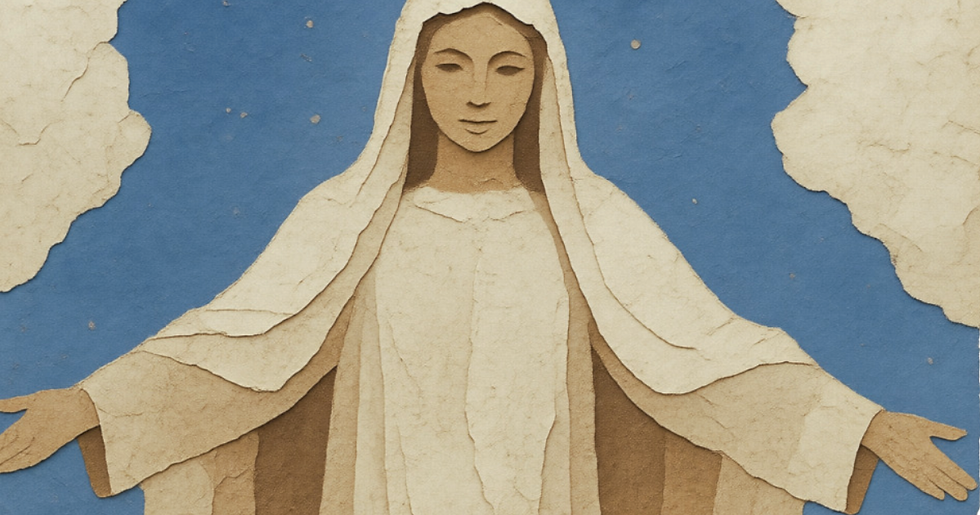
"I saw a lady dressed in white. She wore a white dress, an equally white veil, a blue belt, and a yellow rose on each foot."
The Lady held a rosary. Bernadette, not knowing who or what she was seeing, called her simply aquero, "that one" in the Occitan dialect. She was not a theologian making a claim. She was a child describing what she saw.
Bernadette made the Sign of the Cross with the Lady, and they prayed the Rosary together in silence. When the prayer ended, the Lady vanished.
It was the first of eighteen apparitions that would stretch from February to July of that year.
What She Said
Our Lady did not speak during the first two apparitions. She smiled. She prayed. She was present. When she finally spoke at the third apparition, on February 18, her first words were an invitation, spoken with a courtesy that stunned Bernadette, because no one had ever spoken to her with such respect.
"Would you be so kind as to come here for fifteen days?"
She addressed Bernadette with the formal "you," something this poor, overlooked girl had never experienced from anyone. And then she added a promise that was not what the world would offer:
"I do not promise to make you happy in this world, but in the next."
During the days that followed, Our Lady's messages grew more urgent. On February 24, she spoke a word the world needed to hear then and still needs to hear now:
"Penance! Penance! Penance! Pray to God for sinners."
On February 25, she gave Bernadette an instruction that made no sense to anyone watching. She told her to go to the back of the grotto and drink from a spring. There was no spring. Bernadette knelt and began to dig in the mud with her hands, smearing the dirty water on her face. The crowd thought she had lost her mind. But that muddy trickle became a flowing spring, and it has not stopped flowing since that day, producing one hundred thousand liters of water daily for over 165 years.
"Go, drink at the spring and wash yourself there."
On March 2, she gave Bernadette a message for the local priests:
"Go, tell the priests that the people are to come here in procession and to build a chapel here."
And then came the moment that changed everything.
The local priest had told Bernadette to ask the Lady her name. She had asked three times and received only a smile. But on March 25, the Feast of the Annunciation, Bernadette asked again. This time, the Lady extended her arms toward the ground, then joined her hands in prayer, looked up toward heaven, and spoke four words in the local dialect:
"Que soy era Immaculada Concepciou."
"I am the Immaculate Conception."
Bernadette did not understand what these words meant. She had never heard the term before. She ran to the parish priest, repeating the phrase over and over so she wouldn't forget it. When the priest heard those words from this uneducated girl, he was shaken.
Because he knew that she could not possibly have invented them.
Four years after the Pope declared the dogma, heaven confirmed it through the lips of a child who didn't even know what she was saying.
The Heart of Her Message
Our Lady's message at Lourdes is simple and it is demanding. It asks something of us.
She calls us to prayer, especially the Rosary, which she held in her hands at every apparition. She calls us to penance, not as punishment but as love turned toward the conversion of sinners. She calls us to come to the water, to be washed and renewed, to drink from a source that does not run dry.
And she reminds us, through the very person she chose, that God does not look at the world the way the world looks at itself. He does not choose the educated, the powerful, or the well-connected. He chose a girl who lived in a dungeon, who couldn't read, who was dismissed by nearly everyone who met her. And through that girl, he poured out a river of grace that has not stopped.
Bernadette never sought fame or attention. She entered a convent in Nevers, France in 1866 and lived out her days in prayer and suffering. She died on April 16, 1879, at the age of thirty-five, her last words being, "Blessed Mary, Mother of God, pray for me." Pope Pius XI canonized her on December 8, 1933. Her body, found incorrupt, still rests in a glass reliquary at the chapel in Nevers.
Since 1858, seventy-two miraculous healings at Lourdes have been verified by the Lourdes Medical Bureau after rigorous scientific and medical examination. Millions of pilgrims visit the grotto every year. The spring still flows. The candles still burn. And Our Lady is still there, in the place where she chose to meet a girl no one else would have chosen, saying the same thing she has always said.
Pray. Do penance. Come to my Son.
Sources and Further Reading
The details of the Lourdes apparitions are drawn from the testimonies of St. Bernadette Soubirous, the records of the canonical investigation led by Bishop Laurence of Tarbes (completed in 1862), and the extensive historical documentation maintained by the Sanctuary of Our Lady of Lourdes. All excerpts of Our Lady's words are from Bernadette's recorded testimony.
For those who want to go deeper:
The Message of Lourdes · Official Sanctuary of Our Lady of Lourdes
The Apparitions · Lourdes Volunteers
Lourdes and St. Bernadette · EWTN
Our Lady of Lourdes · Franciscan Media


Comments