
Our Lady of Pellevoisin

Updated: May 17
Pellevoisin, France · February 14 – December 8, 1876
TLDR
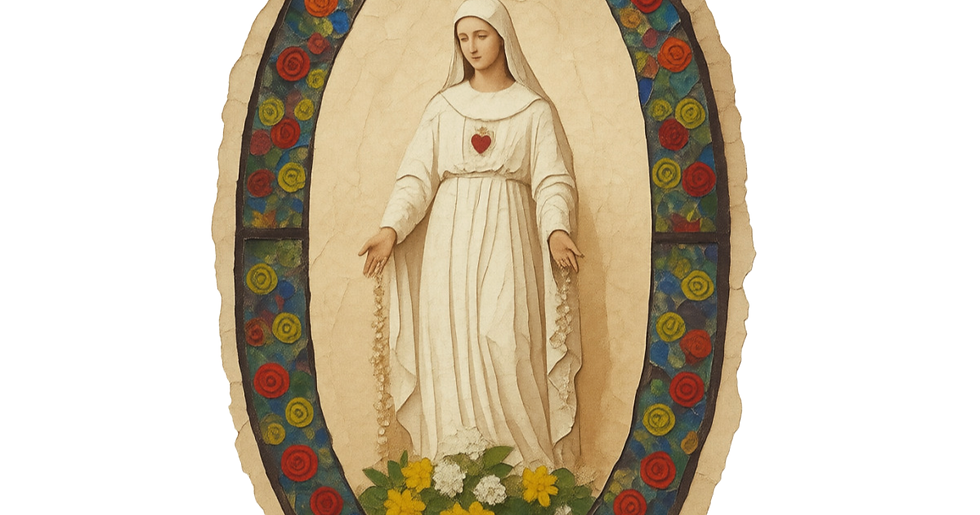
She appeared fifteen times to a dying servant, beginning by driving a demon from the foot of her bed and saying, "Fear nothing, you are my daughter." Estelle was healed from tuberculosis, peritonitis, and a tumor after five days of suffering offered in honor of the five wounds of Christ. Our Lady said, "My Son's Heart is so full of love that He will not refuse my demands," and asked Estelle to spread the Scapular of the Sacred Heart and to "Publish my glory." Cardinal Fernández noted that "even more than the few words of Mary, what is striking is her silent presence, those long silences where the Mother's gaze heals the soul."
Year | 1876 |
Location | Pellevoisin, France |
Visionary | Estelle Faguette |
Apparitions | 15 |
Church Status | Nihil Obstat by DDF (August 2024); cure declared miraculous (1983) |
Key Message |
Scapular of the Sacred Heart. |
The World She Entered
In a small French village not far from Tours, a young woman was dying, and no one could save her.
France in 1876 was a nation in spiritual turmoil. The Franco-Prussian War had ended five years earlier in humiliation. The Paris Commune had left the capital scarred. Anticlericalism was on the rise, and the culture was turning away from the faith with a mixture of indifference and hostility. Our Lady had already wept at La Salette thirty years before and would appear at Lourdes eighteen years prior. She was not done with France.
But this time she did not come to a grotto or a mountainside. She came to a sickbed. She came to a dying woman in a rented room beside a parish church, and she fought the devil at the foot of the bed before she said a word.
To Whom She Appeared
Estelle Faguette was thirty-three years old, a domestic servant and nursemaid in the household of the Comte and Comtesse de La Rochefoucauld. She was a woman of fragile health who had devoted her working life to caring for others. She supported her aging parents and an orphaned niece with whatever she earned.
By early 1876, she was dying. Pulmonary tuberculosis, acute peritonitis, and an abdominal tumor had reduced her to a skeleton. On February 10, her doctor gave her hours to live. Her employers arranged for her to be moved to a small house near the parish church in Pellevoisin so she could be close to the sacraments at the end.
In September of the previous year, knowing she was dying, Estelle had written a letter to the Blessed Virgin Mary. It was a simple, honest letter, asking for a cure so that she could continue to care for her parents. She asked a friend to hide the letter at the feet of a statue of Our Lady of Lourdes in the park at Poiriers. The letter would not be found again until nearly a year later.
Cardinal Fernández of the Dicastery for the Doctrine of the Faith would later write of that letter: "Her words are striking in their simplicity, clarity, and humility. This generous dedication to others, this life that is used to take care of others, is what touched the Mother's heart the most."
How She Appeared
On the night of February 14, 1876, a demon appeared at the foot of Estelle's bed.
And then, immediately, the Blessed Virgin appeared at her side and rebuked the demon, which fled instantly. Our Lady looked at Estelle and spoke her first words:
"Fear nothing, you are my daughter. Have courage, for you are to suffer for five more days in honor of the five wounds of Christ. On Saturday, you will be either dead or cured."
The next night, the devil returned at the same moment as Our Lady. She said:
"Be not afraid, for I am here. This time my Son is showing His mercy. He will let you have life. On Saturday you will be healed."
Estelle, who had made her peace with death and felt ready to go, told Our Lady she would rather die if she could choose. Our Lady smiled and said:
"Ungrateful! If my Son gives you life, it is because you need it. What other more precious thing can He give the people on earth other than life?"
Over the next three nights, Our Lady came each time. She reviewed Estelle's past, showing her both her failures and the good she had done. When Estelle saw her sins, she was overcome with sadness. Our Lady remained silent, watching with an expression of goodness, and then gently reassured her that her self-denial had "put right the wrongs."
On Saturday, February 19, Estelle received Holy Communion. At that moment, she was completely healed. She could eat, drink, and walk. Within days, she had returned to her household duties with no sign of fatigue. A woman given hours to live would live another fifty-three years.
What She Said
Our Lady appeared to Estelle fifteen times throughout 1876, the final apparition coming on December 8, the Feast of the Immaculate Conception. Her messages were intimate, maternal, sometimes gently teasing, and always centered on her Son's Sacred Heart.
She spoke of her power of intercession:
"I am all-merciful and have great influence over my Son."
"My Son's Heart is so full of love that He will not refuse my demands."
She spoke of what pained her most:
"What distresses me most is the lack of respect for my Son."
She asked Estelle to spread devotion to the Sacred Heart through a scapular she wore on her own breast, saying:
"I love this devotion."
"I have many graces in store for those who wear this scapular with trust in me. These graces are my Son's. I bring them from His Heart. He will refuse me nothing."
And on her final visit, she gave Estelle the mission that would define the rest of her life:
"Publish my glory."
The Heart of Her Message
But Cardinal Fernández, in granting the Nihil Obstat to Pellevoisin in August 2024, pointed to something deeper than any individual message. He wrote: "Even more than the few words of Mary, what is striking is her silent presence, those long silences where the Mother's gaze heals the soul."
Estelle herself described those silences: "My God, how beautiful she was! She remained still for a long time without saying anything. After this silence, she looked at me. I don't know what I felt. How happy I was!" And again: "She didn't say anything. Then she looked at me with a very kind look and left." And: "What kindness in her gaze and what mercy!"
This is what sets Pellevoisin apart. At most apparitions, the words carry the message. At Pellevoisin, the silence carries the healing. Our Lady's gaze, resting on a dying woman with kindness and mercy, was itself the grace. She did not need to explain. She simply looked at Estelle the way a mother looks at her child, and in that gaze, everything was said.
Pope Leo XIII encouraged pilgrimages to Pellevoisin and approved the Scapular of the Sacred Heart in 1900. Pope Benedict XV said, "Pellevoisin was chosen by the Holy Virgin as a special place to spread her graces." In 1983, Archbishop Paul Vignancour formally declared Estelle's cure to be medically inexplicable and worthy of being regarded as miraculous. In August 2024, the Dicastery for the Doctrine of the Faith granted the Nihil Obstat to the devotion, recognizing the spiritual fruits of Pellevoisin and the value of the messages.
Estelle Faguette entered the Dominican Third Order in 1925. She died on August 23, 1929, at the age of eighty-six, in the same village where a dying woman had been told she was a daughter, fought for by a Mother, and given back a life she thought was over.
Sources and Further Reading
The details of the Pellevoisin apparitions are drawn from the testimony of Estelle Faguette recorded during the canonical investigation by the Diocese of Bourges, the declaration of Archbishop Paul Vignancour (1983) recognizing the cure as medically inexplicable, and the letter of the Dicastery for the Doctrine of the Faith (August 2024) signed by Cardinal Víctor Manuel Fernández granting the Nihil Obstat. Pope Leo XIII approved the Scapular of the Sacred Heart in 1900, and Pope Benedict XV blessed the shrine. All excerpts of Our Lady's words are from Estelle's recorded testimony.
For those who want to go deeper:
Sanctuary of Our Lady of Pellevoisin · Official Shrine
Our Lady of Pellevoisin: A Pre-Apparition Marian Gains Vatican Approval · National Catholic Register
Pellevoisin (France) 1876 · MaryPages
Our Lady of Pellevoisin, France, 1876 · Divine Mysteries and Miracles


Comments