
Mother of the Word

Updated: Jun 4
Kibeho, Rwanda · November 28, 1981 – November 28, 1989
TLDR
She appeared to three teenage girls in a Rwandan boarding school and showed them a vision of a river of blood, decapitated heads, and abandoned corpses, exactly what would happen in the 1994 genocide twelve years later. She pleaded, "Repent, repent, repent!" and "Convert while there is still time." She taught them the Rosary of the Seven Sorrows and said, "I am the Mother of God. But I am simple and humble. I'm always in the place where you are." Marie Claire, the visionary who went from skeptic to believer, was killed in the genocide at the very site where Our Lady had appeared.
Year | 1981-89 |
Location | Kibeho, Rwanda |
Visionary | Alphonsine, Nathalie, Marie Claire |
Apparitions | 8 years |
Church Status | Fully approved (2001); only approved African apparition |
Key Message |
Vision of genocide 12 years before it happened. Marie Claire killed in genocide. Rosary of Seven Sorrows. |
The World She Entered
Rwanda in 1981 was a country that looked peaceful from the outside.
A small, deeply Catholic nation in the heart of Africa, roughly sixty-five percent of its population was baptized. The churches were full. The schools were running. On the surface, everything seemed fine. But beneath the surface, a wound was growing that no one wanted to name. Ethnic tensions between the Hutu and Tutsi communities had been simmering for decades, woven into the politics, the schools, and the daily life of the nation. Hatred was being carried quietly, neighbor to neighbor, like a fire burning underground.
In twelve years, that fire would erupt into one of the worst genocides in human history. In one hundred days, between April and July of 1994, between eight hundred thousand and one million people would be slaughtered, many by their own neighbors, many with machetes. The rivers would literally run red with blood.
Our Lady knew what was coming. And she came to warn them. Not to a president or a bishop, but to three teenage girls in a boarding school in a village that most of the world had never heard of.
She came to Africa for the first time in the history of approved apparitions. And she came with tears.
To Whom She Appeared
Three girls, all students at Kibeho High School, a Catholic boarding school run by nuns in southwestern Rwanda.
Alphonsine Mumureke was sixteen. Her surname means "Leave her alone; she tells the truth." She was a quiet, hardworking student from a poor family, a girl who attended Mass faithfully but was not considered exceptional by anyone around her. She was serving food in the school cafeteria on November 28, 1981, when she heard a voice calling her name.
Nathalie Mukamazimpaka was twenty. Her surname means "One who settles arguments and brings peace." She received her first apparition on January 12, 1982. Her messages focused on the necessity of unceasing prayer and the acceptance of suffering as a form of love.
Marie Claire Mukangango was twenty-one. She had been one of Alphonsine's harshest critics, openly mocking her and trying to expose her as a fraud. Our Lady appeared to her on March 2, 1982, and the girl who had been the loudest skeptic became the third visionary. Marie Claire's messages focused on the Rosary of the Seven Sorrows and the urgent need for repentance.
Our Lady chose the believer, the peacemaker, and the doubter. She left no one out.
How She Appeared
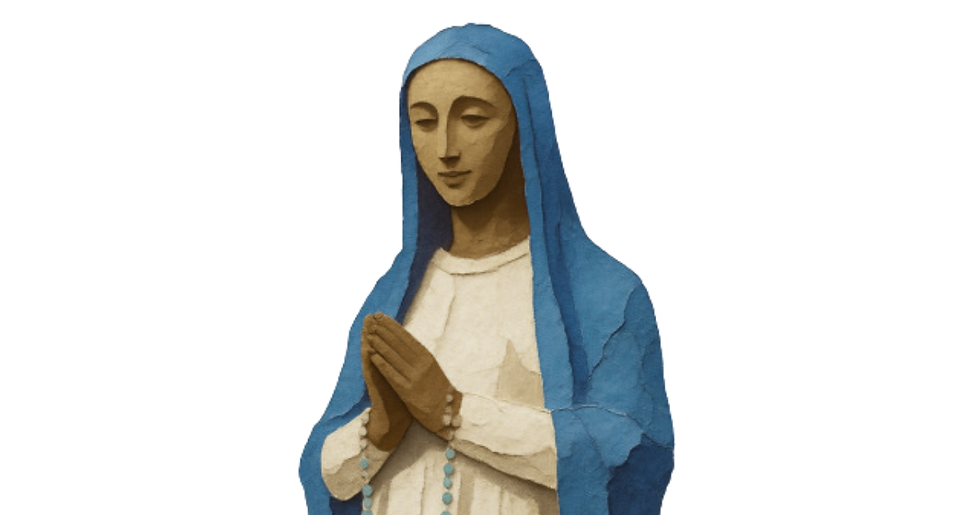
On November 28, 1981, Alphonsine was serving food in the school dining hall when she heard a voice calling her name. She followed the voice and saw a woman of incomparable beauty, dressed in a seamless white gown and a white veil, her hands joined in prayer. The woman was radiant, and her skin was neither black nor white but of a color Alphonsine could not describe.
Alphonsine asked the woman who she was.
The answer came in Kinyarwanda, the native language of Rwanda:
"Ndi Nyina wa Jambo."
"I am the Mother of the Word."
She explained that this title was the same as "Mother of God," spoken in a way that the people of Rwanda could understand and hold close. She was not introducing a new theology. She was translating an eternal truth into the language of their hearts.
Alphonsine was met with disbelief, ridicule, and open hostility from her classmates, her teachers, and the school administration. Marie Claire, especially, was furious and worked to discredit her. But Our Lady had told Alphonsine to be patient and to trust. And when Alphonsine prayed that Our Lady would appear to someone else so that people would believe, the Blessed Mother answered by appearing to the very girl who had been mocking her most loudly.
The apparitions continued for eight years, from November 28, 1981 to November 28, 1989. They were characterized by long ecstasies, songs of praise, prayers of intercession, and messages that moved between profound tenderness and devastating urgency. Crowds grew from a handful of students to tens of thousands of pilgrims.
What She Said
Our Lady's messages at Kibeho were abundant, loving, and increasingly desperate as the years passed and the people did not listen.
She called for conversion again and again:
"Repent, repent, repent!"
"Convert while there is still time."
She made clear that her message was not just for Rwanda:
"When I show myself to someone and talk to them, I want to turn to the whole world."
She pleaded with them about the state of the world:
"The world is evil and rushes towards its ruin. It is about to fall into its abyss. The world is in rebellion against God. Many sins are being committed. There is no love and no peace. If you do not repent and convert your hearts, you will all fall into an abyss."
She asked for the Rosary, as she always does, but at Kibeho she added something specific. She taught the visionaries the Rosary of the Seven Sorrows, an ancient devotion meditating on the suffering of the Blessed Virgin, and asked that it be prayed every Tuesday and Friday. She said the Rosary was one of the most powerful tools in the world to defend against temptation and evil.
She asked them to love God in truth, to love their neighbor in humility and simplicity, to obey the Church, and to live lives of penance and sacrifice.
And then came August 15, 1982.
The Vision
It was the Feast of the Assumption, a day that should have been filled with joy. Twenty thousand people had gathered at Kibeho. Our Lady appeared to the three girls, and this time, she was weeping.
What followed was unlike anything at any other approved apparition.
All three girls began to scream. They wept, trembled, and cried out in horror. Our Lady was showing them the future. They described what they saw: a river of blood, people killing each other, decapitated heads, abandoned corpses with no one to bury them, trees on fire, a gaping abyss. The crowd was paralyzed with fear. Some ran. Some fell to their knees. Some wept with the girls.
Alphonsine cried out:"I see a river of blood! What does that mean?"
Our Lady was showing them exactly what would happen in Rwanda twelve years later. The machetes. The rivers clogged with bodies. The neighbors turning on neighbors. The churches where people fled for sanctuary becoming slaughterhouses. Every detail of what the girls saw on August 15, 1982, came to pass in the spring of 1994.
She had warned them. She had begged them to repent, to love one another, to pray. The warning was not heeded.
The Heart of Her Message
Marie Claire Mukangango, the girl who went from skeptic to visionary, was killed during the genocide in 1994 along with her husband. She died at Kibeho itself, the very place where Our Lady had shown her the river of blood twelve years before.
Nathalie Mukamazimpaka fled Rwanda during the genocide, living as a refugee in Congo and then Kenya before returning to Kibeho after the war. She still lives there today, near the sanctuary.
Alphonsine Mumureke escaped the genocide and eventually entered religious life. She became a cloistered nun, giving her life entirely to prayer, which is what Our Lady had asked for from the very beginning.
On June 29, 2001, Bishop Augustin Misago of Gikongoro formally declared that the apparitions of Our Lady to the three girls were authentic, making Kibeho the only approved Marian apparition in the history of Africa. The Holy See released the declaration.
The message of Kibeho is the message of a Mother who saw what was coming and tried with everything she had to stop it. She did not come with gentle smiles and quiet reassurances. She came with tears and screams and visions of blood because that is how much she loved them, enough to show them the horror that awaited if they did not change.
And yet even in the darkness of that message, there is light. She came. She warned. She wept. She taught them the Rosary of the Seven Sorrows, a prayer born from her own suffering, because she knew that only by entering into her sorrow could they begin to understand the depth of God's love and the cost of turning away from it.
She said her message was for the whole world. And it is. The hatred that consumed Rwanda lives in every human heart that chooses division over love, resentment over forgiveness, silence over truth. She is saying to all of us what she said to those three girls in a boarding school in Africa: Repent. Convert. Pray. Love your neighbor. While there is still time.
Marie Claire once said that one of Our Lady's greatest sorrows during all her visits to Kibeho was that not enough people truly listened.
She is still speaking. The question is whether we will listen.
Sources and Further Reading
The details of the Kibeho apparitions are drawn from the testimonies of the three approved visionaries, Alphonsine Mumureke, Nathalie Mukamazimpaka, and Marie Claire Mukangango, as recorded during the theological and medical investigations conducted by the Diocese of Butare (beginning April 1982) and the formal declaration of Bishop Augustin Misago of Gikongoro (June 29, 2001). Additional material is drawn from Immaculée Ilibagiza's book Our Lady of Kibeho: Mary Speaks to the World from the Heart of Africa. All excerpts of Our Lady's words are from the visionaries' recorded testimony.
For those who want to go deeper:
Brief Overview of the Apparitions · Sanctuary of Our Lady of Kibeho (Official)
Our Lady of Kibeho: An Urgent Appeal · National Catholic Register
Kibeho, Rwanda (1981-1989) · The Miracle Hunter


Comments