
Our Lady of Caravaggio

Caravaggio, Lombardy, Italy · May 26, 1432

TLDR
She appeared weeping golden tears to a woman gathering grass in a field and revealed that she had been interceding for the people of Caravaggio for seven years without their knowledge: "For seven years I have implored mercy from my Son for their sins." A miraculous spring appeared where she stood, a dry branch planted by a skeptic burst into bloom, and her footprints remained imprinted in the stone.
Year | 1432 |
Location | Caravaggio, Italy |
Visionary | Giannetta Vacchi (also known by her married name, Varoli) |
Apparitions | 1 |
Church Status | Bishop approved (1432); Minor Basilica (1906) |
Key Message |
Golden tears. Miraculous spring appeared. |
The World She Entered
Northern Italy in 1432 was a land drenched in violence.
The republics of Venice and Milan were locked in a power struggle that turned the countryside into a battlefield. Caravaggio, a small town in Lombardy between the two warring states, sat directly in the crossfire. Armies marched through, looted, and left destruction behind them. The people lived in constant fear, caught between forces they could not control.
But the violence was not only on the battlefield. In the homes of the poor, suffering took quieter forms. Giannetta Varoli knew this firsthand. She had wanted to become a nun, but her father made her marry instead. Her husband, Francesco, was cruel and afflicted with alcoholism. Her life was not what she had imagined it would be, and the weight of it pressed down on her every day.
On the evening of May 26, 1432, Giannetta was doing what she did every evening. She was cutting grass in a field along the road to Misano to feed her animals. It was five o'clock, and she was tired and alone and thinking about how she was going to carry the bundles home.
And then, from above, a woman came down and stood beside her.
To Whom She Appeared
Giannetta Varoli was thirty-two years old, the daughter of Pietro Vacchi. She was known in the village for her virtuous life, her Christian piety, and her sincere honesty. Despite the hardships of her marriage, she had not become bitter. She carried her cross without complaint, and the people of Caravaggio respected her for it.
She was not a mystic or a visionary. She was a working woman at the end of a long day, gathering grass for the animals, when heaven walked up and stood next to her.
How She Appeared
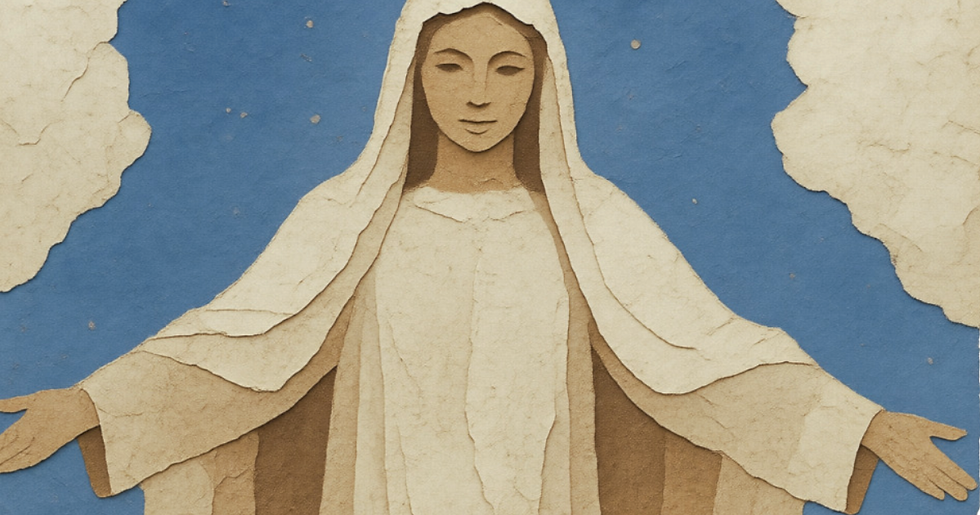
What Giannetta saw was a Lady of majestic stature, with a graceful face and a beauty she later described as unspeakable and never imagined. She wore a blue dress and a white veil over her head. The ancient account says she came "from above" and stopped right beside Giannetta.
Giannetta recognized her immediately. She exclaimed, "Virgin Mary!"
Our Lady placed her hand on Giannetta's shoulder and gently pressed her to her knees. And then she began to speak, with tears in her eyes that Giannetta described as being like shimmering gold.
What She Said
Our Lady's words at Caravaggio reveal a Mother who has been fighting for her children behind the scenes longer than they know:
"My most High Almighty Son intended to annihilate this land because of the iniquity of men, because they do what is evil every day more and more, and fall from sin to sin. But for seven years I have implored mercy from my Son for their sins."
Seven years. For seven years she had been standing between the people of Caravaggio and the consequences of their choices, pleading with her Son for mercy. They did not know it. They could not see it. But she had been interceding for them while they went on sinning, and her intercession had held back the punishment they deserved.
She asked for penance and devotion, fasting on Fridays in honor of her Son and the celebration of Saturdays in devotion to her. And she spoke with open hands, as if she were afflicted, sharing her sorrow with the only person in that field who could hear her.
Giannetta, like so many visionaries before and after, responded with the only objection she had:"People won't believe me."
And Our Lady answered with a promise that she has kept for nearly six hundred years:
"Arise, do not be afraid. You report what I have commanded you. I will confirm your words with such great signs that no one will doubt that you have spoken the truth."
She made the sign of the cross over Giannetta. And then she disappeared, leaving behind the imprint of her feet on the stone where she had stood.
The Heart of Her Message
Giannetta hurried back to Caravaggio and told everyone what had happened. They met her with scorn and derision. No one believed her.
But then the signs came, just as Our Lady had promised.
A spring of water appeared at the spot where Giannetta had been kneeling, a spring that had never existed before. People came to bathe in it and discovered that their illnesses vanished. The healings multiplied. The sick arrived from across the region and went home cured. Word spread, and the crowds grew until the little field by the road to Misano became one of the most visited pilgrimage sites in Italy.
One story from the early days captures the power of the place. A skeptic named Graziano came to challenge the apparition. He took a dry branch, planted it in the ground where Our Lady's feet had stood, and said he would believe if it bloomed. The branch immediately burst into flowers and leaves.
Just two months after the apparition, the Bishop of Cremona authorized the construction of a church at the site. The Duke of Milan helped build the first shrine. In 1575, Saint Charles Borromeo, that great reformer of the Church, commissioned the celebrated architect Pellegrino Pellegrini to enlarge it into the magnificent sanctuary that stands today. Pope Clement XI granted a pontifical coronation in 1710. Pope Pius X raised the shrine to the status of Minor Basilica in 1906.
The spring still flows from beneath the stone where Our Lady stood. The imprint of her feet is still venerated. Over two and a half million pilgrims visit the sanctuary every year.
And here is a detail that ties Caravaggio to another apparition in this collection. Three hundred years later, a farmer named Giacomo Moser traveled from the village of Montagnaga to the Sanctuary of Caravaggio and brought back a painted image of the Madonna. He placed it on the altar of a small chapel in Montagnaga each year on May 26, the anniversary of the apparition. A young shepherdess named Domenica Targa longed to make the pilgrimage to Caravaggio herself but could not get her parents' permission. And Our Lady appeared to Domenica in 1729 and said, "Do not go to Caravaggio. Go to the chapel of Saint Anne instead." The Mother of Caravaggio came to Montagnaga because one woman's longing was enough to bring her.
The message of Caravaggio is that Our Lady has been interceding for us longer than we know, carrying burdens we cannot see, holding back consequences we have earned. For seven years she pleaded before anyone in Caravaggio knew she was pleading. She did not wait for them to ask. She simply loved them, and love intercedes.
And when she finally spoke, she wept golden tears and said, report what I have told you, and I will confirm it with signs. She has been confirming it ever since. The spring still flows. The sick are still healed. The dry branches still bloom.
Sources and Further Reading
The details of the Caravaggio apparition are drawn from the ancient account preserved at the Sanctuary of Santa Maria del Fonte in Caravaggio, the authorization of the Bishop of Cremona (July 31, 1432), and the historical records maintained by the shrine. Pope Clement XI granted a pontifical coronation in 1710. Pope Pius X elevated the shrine to Minor Basilica in 1906. All excerpts of Our Lady's words are from the recorded testimony of Giannetta Varoli.
For those who want to go deeper:
Our Lady of Caravaggio · The Miracle Hunter
The Apparition of Our Lady at Caravaggio · God Won the Victory
Caravaggio, Italy · The Catholic Travel Guide


Comments