
Our Lady of Guadalupe

Updated: Jun 6
Tepeyac Hill, Mexico · December 9-12, 1531

TLDR
Our Lady appeared to St. Juan Diego with indigenous features and Aztec symbols, speaking his native Nahuatl, and left her miraculous image on his tilma, a cactus-fiber cloak that should have disintegrated within decades but remains intact nearly five hundred years later. The image contains details that no human artist could have produced, and within seven years of the apparition, eight to nine million indigenous people converted to Christianity. She is the most visited Marian image in the world.
Year | 1531 |
Location | Mexico City, Mexico |
Visionary | St. Juan Diego |
Apparitions | 4 |
Church Status | Fully approved; image scientifically inexplicable; 8-9 million conversions |
Key Message | Tilma miracle.
Appeared with indigenous features. |
The World She Entered
Ten years after the fall of the Aztec Empire, Mexico was a land torn apart.
The Spanish conquest of 1521 had not only toppled an empire, it had shattered an entire way of life. The temples were destroyed. The old gods were gone. Epidemic diseases, smallpox, measles, and typhus swept through a people who had no immunity, and millions died.
The Spanish missionaries, Franciscans, Dominicans, and Augustinians, had been laboring to share the Christian faith, but progress was slow. By 1531, only about 200,000 indigenous people had been baptized. The God of the Europeans still felt like the God of the conquerors. The people were grieving. They were displaced. They were dying. And they were waiting, without knowing it, for a Mother.
Into that broken world, heaven spoke.
To Whom She Appeared
His name was Juan Diego Cuauhtlatoatzin, which means "he who speaks like an eagle." He was born around 1474 in Cuauhtitlan, near present-day Mexico City. He was a humble man, a Chichimec peasant, not wealthy and not prominent. He had recently lost his wife, Maria Lucia, and was living with his elderly uncle, Juan Bernardino. Both had been among the early converts to the Catholic faith, baptized around 1525 by Franciscan missionaries.
On the morning of Saturday, December 9, 1531, Juan Diego was walking to Mass and catechesis at the mission church in Tlatilolco. It was the Feast of the Immaculate Conception in the Spanish Empire. He was fifty-seven years old, a widower, a quiet believer making his way through an ordinary morning.
He had no idea what was about to happen.
How She Appeared
As Juan Diego passed the hill of Tepeyac, he heard singing. Beautiful, otherworldly singing, like the song of many exotic birds. When the singing stopped, he heard a voice calling his name.
"Juanito. Juan Dieguito."
He climbed the hill and found a young woman standing there, radiant as the sun. The rock beneath her feet glistened like precious stones. The plants around her, the mesquites and cactus, glowed as if they were made of emeralds and gold. She spoke to him in Nahuatl, his own language, with a tenderness that the original account describes as soft, courteous, and deeply affable, as if she cared for and esteemed him greatly.
She called him the littlest of her sons.
She spoke to him not as a queen addressing a subject but as a mother calling her child by name.
What She Said
Our Lady revealed herself and her desire in words that have echoed across five centuries. From the Nican Mopohua:
"Know and hold as certain, littlest of my sons, that I am the Ever-Virgin Holy Mary, Mother of the true God, by Whom you live, the Creator of all, the Lord of Heaven and earth."
"I strongly desire that a temple be erected here, in which I will manifest and give all my love, compassion, aid and protection, because I am your loving Mother; the Mother of you and all the inhabitants of the earth; a Mother to those who love me, who call upon me, who seek me and trust in me."
"I will hear all their cries here, and remedy all their miseries, sorrows, and pains.
She sent Juan Diego to Bishop Fray Juan de Zumárraga with her request. The Bishop listened but did not believe him. Juan Diego returned to the hill, discouraged, and begged Our Lady to send someone more important, someone the Bishop would take seriously. He called himself "a little man of the country, an old piece of leather... insignificant."
Her response is one of the most beautiful things she has ever said to any of her children:
"Listen, littlest of my sons; understand that there are many of my servants and messengers, whom I could entrust to deliver my message and do my will, but it is absolutely necessary that you yourself help and make the request, and that it be through your mediation that my will be fulfilled."
She wanted him. Not someone important. Not someone powerful. Him.
The Miracle Unfolds
Over the next three days, the story unfolded with the tenderness and persistence that only a mother could sustain.
Juan Diego returned to the Bishop a second time, and the Bishop asked for a sign. Our Lady promised to provide one. But the next day, Juan Diego's uncle fell gravely ill, and Juan Diego, afraid his uncle was dying, tried to avoid the hill so Our Lady would not delay him. He went around the other side, hoping she wouldn't see him.
But she came to meet him on the road.
And when he told her, embarrassed and afraid, that his uncle was dying, she spoke words that have comforted millions of hearts since that December morning:
"Listen and understand, littlest of my sons, let nothing frighten you, nothing trouble you; let nothing disturb your countenance or your heart. Do not fear that disease or any other illness or affliction. Am I not here, your Mother? Are you not under my shadow and protection? Am I not the source of your joy and your health? Are you not in the hollow of my mantle, in the crossing of my arms? Is there anything else that you need?"
At that very moment, his uncle was healed.
She then sent Juan Diego to the top of the hill to gather flowers. There, in the dead of winter, on rocky ground where only thorns and cactus grew, he found an abundance of Castilian roses in full bloom, covered in morning dew. He gathered them in his tilma, his cloak, and brought them to Our Lady. She arranged them with her own hands and told him to show them to the Bishop.
When Juan Diego opened his tilma before the Bishop, the roses cascaded to the floor. But the sign was not the roses.
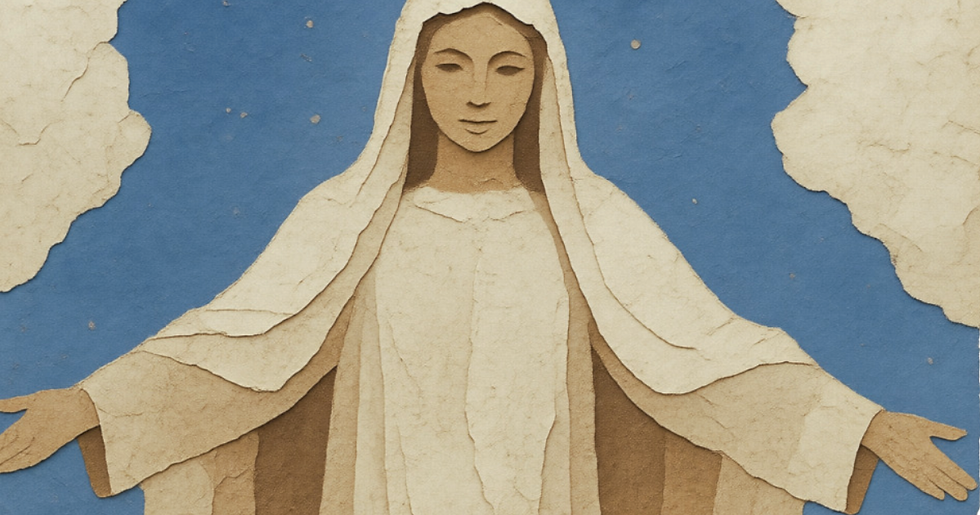
There on the rough cactus-fiber cloth was an image of the Blessed Virgin Mary, painted by no human hand. The image of a young woman with indigenous features, standing on the moon, wrapped in a blue-green mantle covered in stars, with the sun radiating behind her. She was looking down with humility and compassion. She was human, not God. And she was pointing, as she always does, beyond herself.
The Bishop fell to his knees.
The Heart of Her Message
Everything Our Lady said at Guadalupe carries one heartbeat. She is our Mother. She is here. And she wants to bring us to her Son.
She did not come with complicated theology. She did not come with demands or conditions. She came with love, spoken in the language of the people she was visiting, dressed as one of them, appearing not to a king or a bishop but to the smallest and most forgotten among them. She asked for a house where she could give her love, compassion, help, and protection to all who seek her.
And she reminded Juan Diego, and through him all of us, that we are never too small, too insignificant, or too broken to be chosen. That we are always held. That there is nothing to fear. Because she is here, and we are in the hollow of her mantle, in the crossing of her arms.
What more do we need?
In the seven years that followed her apparition, an estimated eight to nine million indigenous people were baptized into the Catholic faith. It was the largest conversion in the history of the Church. A Mother had come for her children, and they recognized her.
Juan Diego spent the remaining seventeen years of his life near the chapel that was built for Our Lady, sharing his story with every pilgrim who came. He died in 1548. Pope John Paul II canonized him on July 31, 2002, the first indigenous saint of the Americas.
The tilma, which should have disintegrated within decades, remains intact to this day, nearly five hundred years later, in the Basilica of Our Lady of Guadalupe in Mexico City. It is the most visited Catholic shrine in the world.
She is still there. And she is still calling.
Sources and Further Reading
The primary source for the apparition of Our Lady of Guadalupe is the Nican Mopohua, written in classical Nahuatl by Don Antonio Valeriano (c. 1520-1606). Valeriano was a scholar and governor who received first-hand testimony from Juan Diego, Juan Bernardino, and Bishop Zumárraga. The oldest known manuscript is preserved in the New York Public Library. All excerpts of Our Lady's words on this page are drawn from translations of this text.
For those who want to go deeper:
Full text of the Nican Mopohua · Our Lady of Guadalupe Monastery, Silver City, NM
Our Lady of Guadalupe · EWTN
The History and Significance of Our Lady of Guadalupe · National Shrine of Our Lady of Guadalupe, La Crosse, WI
St. Juan Diego and the Miracle of Our Lady of Guadalupe · Basilica of the National Shrine of the Immaculate Conception, Washington, D.C.


Comments