
Our Lady of Las Lajas

Guáitara Canyon, Colombia · 1754

TLDR
A deaf-mute girl named Rosa spoke her first words ever, "Mamá, the Mestiza is calling me!" while pointing to a cave in the Colombian Andes. When Rosa later died, her mother carried her body back to the cave and begged Our Lady to intercede, and the child was raised from the dead. A miraculous image of Our Lady was found embedded in the rock, several feet deep, with no paint or pigment of any kind. Scientists have confirmed the colors are the rock itself, and no one can explain how it got there.
Year | 1754 |
Location | Guáitara Canyon, Colombia |
Visionary | María Mueses & daughter Rosa (deaf/mute) |
Apparitions | 2+ |
Church Status | Bishop approved (1758); Minor Basilica (1954); canonically crowned (1952) |
Key Message | Rosa's first words ever: "Mamá, the Mestiza is calling me!" Image embedded in rock several feet deep, no paint. Rosa raised from death. |
The World She Entered
In the remote highlands of southwestern Colombia, where the Andes drop into deep river canyons and the air is thin and cold, the Catholic faith had been planted by Dominican and Franciscan missionaries but was still young and fragile in the hearts of the indigenous people.
The canyon of the Guáitara River was a place the locals feared. A narrow gorge carved into the rock, dark even in daylight, with flat slabs of sedimentary stone jutting from the walls like shelves. The people called them lajas. They believed the place was haunted. No one lingered there longer than they had to.
It was into this feared and forsaken place that Our Lady chose to come, not with words, but with an image so mysterious that science has never been able to explain it. She came for a mute girl in a storm, and she left her portrait burned into the rock itself, several feet deep into the stone, as if the mountain had been waiting for her face since the beginning of the world.
To Whom She Appeared
María Mueses de Quiñones was an indigenous woman from the village of Potosí, about six miles from the town of Ipiales. She was poor and unlettered. She traveled frequently between the two villages on foot, carrying her daughter Rosa on her back in the traditional way.
Rosa had been born deaf and mute. She had never spoken a word, never heard a sound. She lived in complete silence, carried through the world on her mother's back, unable to tell anyone what she saw or felt or needed.
They were the kind of people the world steps over without noticing. And they were exactly the kind of people Our Lady has always chosen.
How She Appeared
One day in 1754, María and Rosa were walking the trail through the Guáitara Canyon when a sudden storm broke over them. Rain lashed the narrow gorge. Lightning split the sky. Frightened, María ducked between the slabs of rock to take shelter, pressing herself against the stone walls of the cave called Las Lajas.
And then her daughter spoke.
For the first time in her life, Rosa opened her mouth and said words her mother had never heard her say, words no one had ever heard her say:
"Mamá, the Mestiza is calling me!"
María froze. Her daughter was pointing at the rock wall. Lightning illuminated the cave, and there, on the stone, María saw a figure: a beautiful woman holding a child, glowing in the flashes of light.
The first sound Rosa ever made was the announcement of her Mother's presence. Like Jeanne Courtel at Querrien, a child who had lived in silence heard the voice of heaven before she heard any other voice on earth.
María grabbed her daughter and ran.
What Happened Next
Days later, Rosa disappeared from home. María, instinctively, knew where to go. She ran to the canyon, to the cave, to the lajas. And there she found her little girl, sitting among the rocks, playing with a child while a beautiful woman stood nearby watching them.
It was the Blessed Virgin Mary and the Child Jesus. Rosa was playing with God.
María and Rosa kept their secret. They returned to the cave often, leaving wildflowers and candles in the cracks of the stone, praying in the quiet of the canyon. But months later, Rosa fell gravely ill. The sickness worsened quickly, and the child died.
A mother who had only just heard her daughter's voice for the first time now carried her daughter's lifeless body back through the canyon, back to the cave, back to the lajas. She placed Rosa before the image on the stone and she begged. She pleaded with the Blessed Virgin to intercede with her Son, to give her daughter back, to undo what death had done.
And Our Lady, who had given Rosa her voice, now gave her back her life.
Rosa opened her eyes. She was alive, healthy, whole. The mute girl who spoke, who died, who was raised from the dead. Three miracles in one child.
María could not keep the secret any longer. She ran to Ipiales and told everyone what had happened. It was nighttime when she arrived. Church bells rang. People got out of bed. A crowd gathered. And at dawn, the entire village walked to the canyon.
When they arrived, supernatural light was streaming from the cave. They went inside. And there, engraved into the stone wall, was the image of the Most Holy Virgin Mary.
The Image
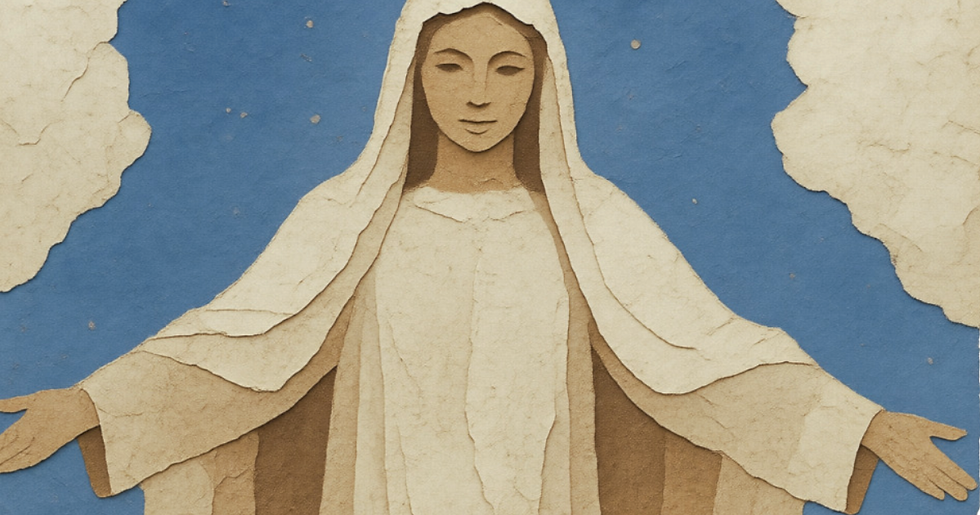
The image depicts Our Lady of the Rosary, standing about 1.4 meters tall. She wears a rose-colored tunic with golden flowers and a white mantle adorned with stars. She holds a rosary in her right hand, extending it toward St. Dominic, who kneels at her side. The Child Jesus, in her arms, extends a Franciscan cord to St. Francis of Assisi, kneeling on the other side.
Rays of light surround them.
The image is not painted.
Geological samples taken by German scientists have confirmed that there is no paint, no dye, no pigment of any kind on the surface of the stone. The colors are the colors of the rock itself. They penetrate uniformly to a depth of several feet into the cliff face. There is no known natural process that could produce a detailed, multi-colored image of human figures inside solid rock. There is no known artistic technique that could embed color several feet deep into stone.
Scientists cannot explain it. The image is classified as acheiropoieta, a Greek word meaning "not made by human hands." Like the tilma of Guadalupe, the image of Las Lajas exists in defiance of every natural explanation. It is there. It has been there since 1754. The colors have not faded. And no one knows how it got there except the One who put it there.
The Heart of Her Message
A blind Franciscan friar named Father Juan de Santa Gertrudis heard about the image and dedicated his life to building a chapel to house it. He walked the length and breadth of the region begging for money, unable to see the road in front of him but certain of where he was going. When the chapel was finally completed in 1764, he knelt before the image and his sight was restored.
The chapel was replaced by a larger church, which was replaced by the stunning neo-Gothic basilica that stands today, built between 1916 and 1949. The church rises from the floor of the canyon on massive pillars, spanning the Guáitara River like a bridge, with more turrets and spires than Notre-Dame in Paris. The miraculous image sits behind the main altar, still embedded in the rock wall that forms the back of the church. The basilica was literally built around the rock that bears her face.
Pope Pius XII granted a canonical coronation of the image in 1952 and elevated the church to a Minor Basilica in 1954. Over seven thousand votive plaques cover the walls, each one a testimony to an answered prayer. Hundreds of wheelchairs and crutches have been left behind by pilgrims who arrived unable to walk and departed healed.
Our Lady of Las Lajas did not speak. She did not deliver a formal message. She did not give secrets or prophecies or instructions for the future. She did something far more permanent. She put her image into the rock itself, so deep that it can never be removed, so vivid that it can never fade, so inexplicable that it can never be explained away.
At Guadalupe, she left her image on a tilma that should have disintegrated five centuries ago. At Las Lajas, she left her image inside the mountain itself. She does not write on paper. She writes on the things that last. Fabric that defies decay. Stone that defies geology. She places herself where she cannot be erased.
And she came for a mute girl in a storm. She gave the girl a voice, then gave her life, and then left her portrait in the rock as if to say: I was here. I am always here. And nothing, not time, not science, not the mountain itself, will ever erase me from this place.
Sources and Further Reading
The details of the Las Lajas apparition are drawn from the oral tradition preserved at the Sanctuary of Las Lajas, the earliest written account by Friar Juan de Santa Gertrudis (c. 1756-1764), and the historical records of the Diocese of Ipiales. The devotion was approved by the Bishop of Quito in 1758. Pope Pius XII granted a canonical coronation in 1952 and elevated the shrine to Minor Basilica in 1954. Geological studies confirming the non-painted nature of the image have been conducted by German and Colombian scientists.
For those who want to go deeper:
Our Lady of Las Lajas, Colombia, 1754 · Divine Mysteries and Miracles
Our Lady of Las Lajas · The Miracle Hunter
The Miraculous Image of Our Lady of Las Lajas · Catholic Exchange
Las Lajas, Colombia · Catholic Pilgrimage Guide


Comments