
Our Lady of the Miraculous Medal

Updated: Jun 9
Rue du Bac, Paris · July 18 – November 27, 1830

TLDR
She appeared to a young novice in Paris and revealed the design of a medal, showing herself standing on a globe, crushing a serpent, with rays of light flowing from her fingers, the graces she longs to give. She said, "Those are the graces for which people forget to ask." Catherine Labouré kept the secret of her identity for forty-six years, and over one billion medals have been distributed worldwide.
Year | 1830 |
Location | Paris, France |
Visionary | St. Catherine Labouré |
Apparitions | 3 major |
Church Status | Fully approved; over 1 billion medals distributed |
Key Message |
46 years of hiddenness. Medal design given by Our Lady herself. |
The World She Entered
Paris in 1830 was a city on fire, and not with faith.
For over a century, the Enlightenment had been pulling France away from God. The French Revolution of 1789 had tried to tear the Church out of the nation by its roots, killing priests, desecrating churches, and enthroning a goddess of reason in Notre-Dame. The decades that followed brought one upheaval after another. By July of 1830, another revolution was erupting. King Charles X was overthrown in three violent days. Churches were attacked, crosses and statues torn down, bishops and priests beaten and imprisoned. The faith that had built France was being driven underground.
It was in that very city, in that very moment, that heaven chose to speak. Not in a cathedral and not to a cardinal, but in a small convent chapel, to a young farm girl who had lost her mother at the age of nine and had asked the Blessed Virgin to take her place.
This is where the modern age of Marian apparitions begins. Everything that would follow over the next two centuries, Lourdes, Fatima, and beyond, starts here, in a quiet chapel on the Rue du Bac.
To Whom She Appeared
Her name was Catherine Labouré. She was born Zoé Labouré on May 2, 1806, in Burgundy, the ninth of eleven children in a farming family. When her mother died, nine-year-old Catherine picked up a statue of the Blessed Virgin, held it close, and said, "Now you will be my mother."
She had little formal education but a deep interior life and a practical, steady temperament. At the age of twenty-four, she entered the Daughters of Charity of St. Vincent de Paul in Paris, beginning her novitiate at the Motherhouse on the Rue du Bac in April of 1830.
She was not mystical or dramatic. She was sensible, hardworking, and quiet. The kind of person you would never notice in a crowd. And that, it turned out, was exactly the kind of person Our Lady was looking for.
How She Appeared
On the night of July 18, 1830, the eve of the Feast of St. Vincent de Paul, Catherine was awakened from sleep by the voice of a child calling her name.
"Sister Labouré, come to the chapel. The Blessed Virgin is waiting for you."
She followed the child, who radiated light wherever he passed, and found the chapel ablaze with brightness. She heard the rustle of a silk dress, and there, seated in a chair near the altar, was the Blessed Virgin Mary. Catherine rushed forward, knelt at her feet, and rested her hands in Our Lady's lap.
She would later call it "the sweetest moment of my life."
They spoke together for two hours. Our Lady told her of the sorrows coming to France and to the world, and then gave her the words that would define the rest of her life:
"My child, the good God wishes to charge you with a mission. You will be contradicted, but do not fear, you will have grace."
She pointed to the altar and said:
"Come to the foot of this altar. Here, graces will be given to all who ask for them with confidence and fervor."
Nine days later, revolution broke out in Paris, just as Our Lady had foretold.
The Medal
Four months later, on the evening of November 27, 1830, Our Lady returned.
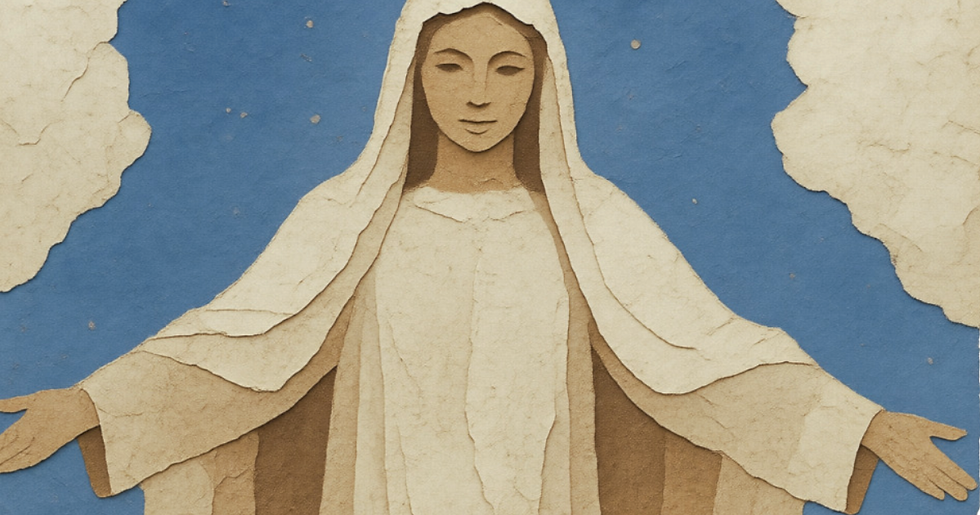
During evening meditation, Catherine heard the familiar rustle of silk and saw the Blessed Virgin standing upon a globe, her foot crushing the head of a serpent. She held a golden ball in her hands, which she seemed to offer to God, and from the jeweled rings on her fingers, brilliant rays of light streamed downward toward the earth.
Catherine heard her voice, though her lips did not move:
"The ball which you see represents the whole world, especially France, and each person in particular. These rays are a symbol of the graces that I pour out on those who ask them of me."
Catherine noticed that some of the gems on Our Lady's rings did not give off light. When she wondered why, Our Lady answered:
"Those are the graces for which people forget to ask."
Then an oval frame formed around the vision, and golden letters appeared, curving around the image like an embrace:
"O Mary, conceived without sin, pray for us who have recourse to thee."
The image turned, and Catherine saw the reverse: a large letter M beneath a cross, with two hearts below it, one crowned with thorns, one pierced by a sword, encircled by twelve stars.
And then Our Lady spoke the words that would send a small medal around the entire world:
"Have a medal made in this image. For those who wear it with confidence, there will be abundant graces."
In a later apparition, she added:
"My eyes are always watching you. I shall grant you many graces. Special graces will be given to all who ask for them, but people must pray."
The Heart of Her Message
Catherine told her confessor everything. He was cautious, as confessors should be, but after two years of observing Catherine's steady, humble character, he brought the request to the Archbishop of Paris. The medal was approved, and the first 1,500 were struck on June 30, 1832.
What happened next can only be described as a flood of grace.
During a deadly cholera epidemic in Paris, the Daughters of Charity began distributing the medals among the sick and the dying. Reports of miraculous healings, conversions, and protections spread so quickly that the Medal of the Immaculate Conception became known simply as the Miraculous Medal. By 1835, over one million had been distributed. By 1839, over ten million. By the time of Catherine's death in 1876, more than one billion medals had been made.
And almost no one knew who the visionary was.
Catherine never told anyone. She spent forty-six years after the apparitions at a hospice in Reuilly, caring for the elderly, tending the farm, feeding the chickens, cleaning the stables. She lived in complete hiddenness, asking for nothing, drawing no attention to herself. She was, as Pope Pius XII would later say at her canonization, "the saint of silence and the dutiful life."
She died on December 31, 1876, at the age of seventy. When her body was exhumed fifty-seven years later, it was found incorrupt. She now rests in a glass reliquary beneath the altar of the very chapel where Our Lady appeared to her on the Rue du Bac.
The message of the Miraculous Medal is as simple as the prayer inscribed on it. Mary is our Mother. She was conceived without sin. She is standing on the serpent. And all the graces of heaven are streaming from her hands toward anyone willing to ask. The only thing that dims those rays is our forgetting to reach out for them.
She is not withholding anything. She is waiting for us to pray.
Sources and Further Reading
The details of the Miraculous Medal apparitions are drawn from the written accounts of St. Catherine Labouré, the records of the canonical inquiry conducted by Canon Quentin on behalf of the Archbishop of Paris (1836), and the historical documentation maintained by the Daughters of Charity and the Chapel of Our Lady of the Miraculous Medal. All excerpts of Our Lady's words are from Catherine's recorded testimony.
For those who want to go deeper:
History of the Apparitions · International Miraculous Medal Association
St. Catherine Labouré and the Miraculous Medal · Daughters of Charity, Province of St. Elizabeth Ann Seton
The Miracle of the Miraculous Medal · Central Association of the Miraculous Medal


Comments