
Our Lady of the Pillar

Zaragoza, Spain · January 2, 40 AD
TLDR
Mary appeared to St. James while she was still alive on earth, bilocating from Jerusalem to Spain to encourage a discouraged apostle who had made only eight converts. She stood on a pillar and promised, "This pillar shall remain in this place until the end of time," and that God would work miracles for all who place themselves under her patronage. Nearly two thousand years later, the pillar has not moved, and three bombs dropped on the basilica during the Spanish Civil War never exploded.
Year | 40 AD |
Location | Zaragoza, Spain |
Visionary | St. James the Apostle |
Apparitions | 1 |
Church Status | Accepted by Pope Innocent XIII (1723); Sacred Congregation of Rites approved |
Key Message |
Mary bilocated while still alive on earth to encourage a discouraged apostle. |
The World She Entered
The Church was days old.
Jesus had ascended into heaven. The Holy Spirit had descended at Pentecost. The twelve Apostles had scattered across the known world to bring the Gospel to every nation. And one of them, James the Greater, the brother of John and son of Zebedee, one of the Sons of Thunder, had traveled to the farthest western edge of the Roman Empire, to the land we now call Spain. He was not having a good time.
The pagans of the Iberian Peninsula were resistant, stubborn, and uninterested in the Gospel of a crucified carpenter from Palestine. Despite his tireless efforts, James had made only a handful of converts. He was exhausted, discouraged, and beginning to wonder if his mission had failed entirely.
It was the year 40 AD. Mary, the Mother of Jesus, was still alive, still living in Jerusalem, still breathing the same air as the Apostles. She had promised James that when he needed her most, she would come to him.
And she kept that promise. In the most extraordinary way imaginable.
To Whom She Appeared
James the Greater was one of the innermost circle of Apostles, present at the Transfiguration, at the raising of Jairus's daughter, and in the Garden of Gethsemane. He knew Jesus intimately. He knew Mary personally. He had eaten meals with her, heard her voice, watched her stand at the foot of the cross. She was not an abstract devotion to him. She was the Mother he had known face to face.
And yet here he was, thousands of miles from home, failing. His converts numbered eight. The whole region seemed impenetrable. He was kneeling on the banks of the Ebro River in the Roman city of Caesaraugusta, which we now call Zaragoza, praying in the dark while his companions slept beside him.
He was at his lowest point. And that, as we have seen at every apparition since, is precisely when she comes.
How She Appeared
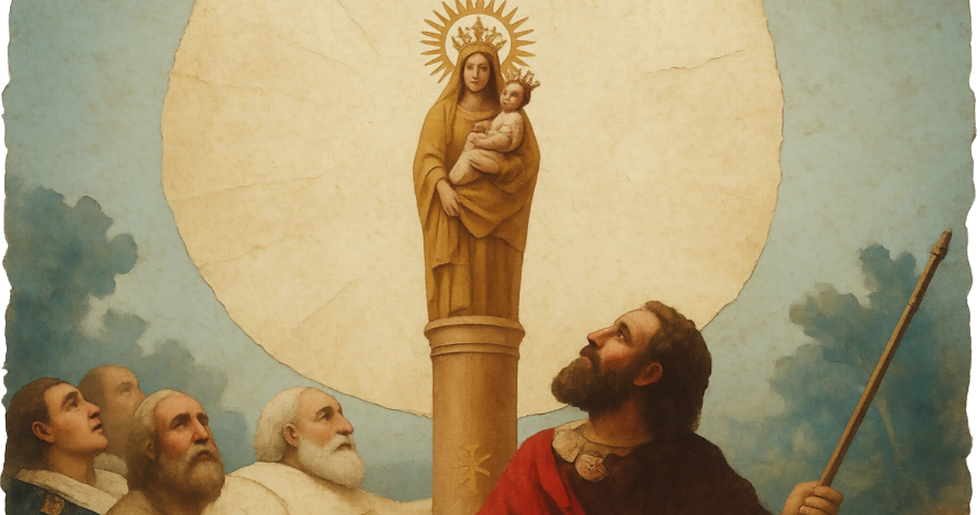
On the night of January 2, in the year 40, as James knelt in prayer by the river, he heard voices. Angels, singing the Ave Maria. Thousands of them. The night sky filled with light and music, and in the center of that light, standing on a pillar of marble, was the Blessed Virgin Mary, holding the Child Jesus in her arms.
She was not dead. She was not appearing from heaven. She was still alive, still in Jerusalem, and yet she was here, on the banks of the Ebro, brought by the hands of angels. It was a bilocation, a miracle within a miracle, the Mother of God appearing in the flesh in two places at once because one of her children needed her and she had promised to come.
The angels themselves had crafted the pillar during the journey, and they placed it on the ground where she stood.
What She Said
Our Lady spoke to James with the authority of a Mother and the tenderness of someone who knows exactly what it feels like to watch a beloved child struggle:
"This, my son, is the place destined for my honor. Here, through your efforts, a church will be built in my memory."
"Behold this pillar on which I stand, for my Son and Master has sent it down from heaven by the hands of angels. Near it you shall place the altar of the chapel, where the power of the Most High will work great wonders through my intercession."
"This pillar shall remain in this place until the end of time."
And then the promise that has sustained nearly two thousand years of unbroken devotion:
"It will stand from that moment until the end of time in order that God may work miracles and wonders through my intercession for all those who place themselves under my patronage."
She left behind the pillar and a small wooden statue of herself holding the Child Jesus. Then the angels carried her back to Jerusalem, and James rose from his knees a different man.
The Heart of Her Message
James and his eight disciples immediately began building a chapel, sixteen feet long by eight feet wide, around the pillar. It was the first church ever dedicated to the Blessed Virgin Mary in the history of the world. James ordained one of his disciples as a priest, consecrated the little chapel, and named it Santa María del Pilar.
Then he returned to Jerusalem, as his Mother had instructed, where he became the first Apostle to be martyred, beheaded by King Herod Agrippa in the year 44 AD. He had given his life for the faith he had struggled to plant, and the pillar remained.
The small chapel was replaced by larger churches over the centuries. It survived the Muslim occupation of Spain. It survived the Reconquista. It survived fire in 1434. And in the Spanish Civil War of 1936-1939, when the Communists dropped three bombs on the basilica, not a single one exploded. They hang from the ceiling of the church to this day, silent witnesses to a promise that has held for nearly two thousand years.
The kisses of pilgrims over the centuries have worn a hole in the jasper pillar so large that a person's head can rest inside it. That is what two thousand years of love look like, worn into stone by the lips of the faithful.
On October 12, Columbus reached the New World, and Our Lady of the Pillar became the patroness of all Hispanic peoples, carrying the faith that James had planted on the Ebro to every corner of the Americas.
Pope John Paul II visited the shrine twice, in 1982 and 1984, and said: "In the firm and ancient tradition of the Pillar, the apostolic dimension of the Church in all its glory shines."
The message of the Pillar is the message that begins everything. Before Guadalupe, before Lourdes, before Fatima, before any other apparition in this collection, there was Zaragoza. A discouraged apostle kneeling by a river. A Mother who had promised to come. And a pillar that has not moved in nearly two thousand years.
She came to the first person who felt like a failure in his mission for God, and she told him to keep going. She gave him something to build around, something solid, something that would outlast empires and wars and centuries of forgetting. And she promised that anyone who places themselves under her patronage, anyone who comes to her and asks, will not be turned away.
That pillar is still there. It has never moved. It has never fallen. And her promise has never been broken.
This is where it all began.
Sources and Further Reading
The tradition of Our Lady of the Pillar is drawn from the ancient oral tradition of the Church in Zaragoza, first recorded in thirteenth-century manuscripts preserved in the archives of the Cathedral of Zaragoza, and expanded upon by Venerable María de Ágreda in her Mystical City of God (17th century). The apparition was accepted as canonical by Pope Innocent XIII in 1723, after investigation by twelve cardinals and approval by the Sacred Congregation of Rites. Pope Pius X granted the image a canonical coronation in 1905. All excerpts of Our Lady's words are from the tradition approved by the Sacred Congregation of Rites.
For those who want to go deeper:
First Marian Apparition: Our Lady of the Pillar · 206 Tours
Our Lady of the Pillar · America Needs Fatima
Nuestra Señora del Pilar · EWTN
Zaragoza, 40 AD · The Miracle Hunter


Comments