
Our Lady of Walsingham

Walsingham, Norfolk, England · 1061
TLDR
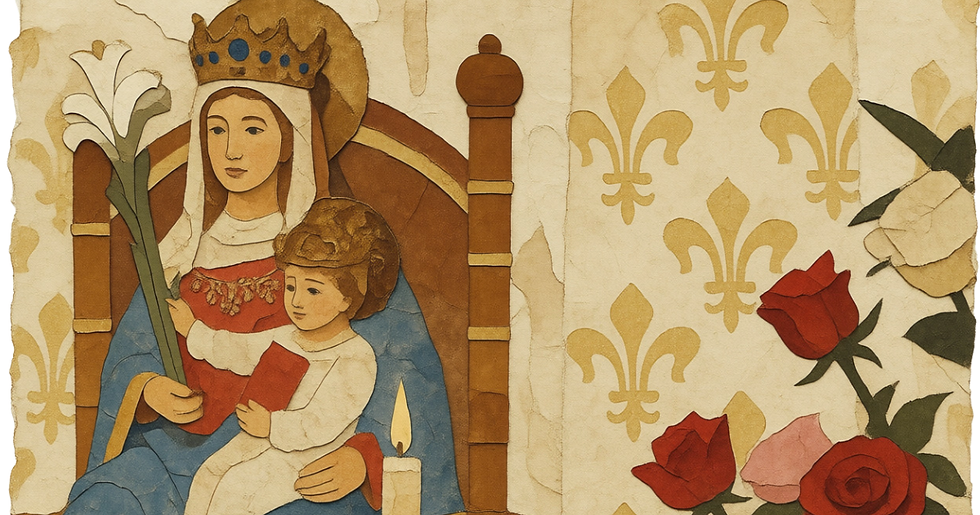
Our Lady appeared three times to a widowed noblewoman, walking her through the streets of Nazareth and showing her the house where the Annunciation took place. She asked Richeldis to build a replica in England so that the poor who could never travel to the Holy Land could come to her instead. She promised, "All who are in any way distressed or in need, let them seek me there. To all that seek me there shall be given succour." Henry VIII destroyed the shrine in 1538, but four hundred years later it was restored, and pilgrims came home.
Year | 1061 |
Location | Norfolk, England |
Visionary | Lady Richeldis de Faverches |
Apparitions | 3 |
Church Status | Traditionally approved; shrine re-established by Pope Leo XIII (1897); image crowned by Pope Pius XII (1954) |
Key Message |
Built replica of Holy House of Nazareth. |
The World She Entered
England in 1061 was a kingdom on the edge of transformation.
Edward the Confessor, the last of the great Anglo-Saxon kings, was on the throne. Within five years, the Norman Conquest would change England forever. The crusades had not yet begun, and the Holy Land was a dream for most English Christians, a place they longed to visit but never would. The journey was too long, too dangerous, and too expensive for anyone but the wealthiest lords.
In a small village in Norfolk, near the North Sea coast, a devout young widow was praying and asking the Blessed Virgin one question: how can I honor you?
Our Lady's answer would turn an unremarkable English village into one of the four greatest pilgrimage sites in all of Christendom, alongside Jerusalem, Rome, and Santiago de Compostela. England itself would become known throughout the world as "the Dowry of Mary," and the road to Walsingham would be walked so often by so many that the Milky Way itself would be nicknamed the Walsingham Way, the path across the sky that pointed pilgrims toward England's Nazareth.
To Whom She Appeared
Richeldis de Faverches was the Lady of the Manor of Walsingham Parva. She was young, widowed, and the mother of a son named Geoffrey. She was known for her deep faith and for her generous care of the poor and suffering around her.
She was not a mystic or a visionary. She was a noblewoman who loved God and loved the Blessed Virgin and wanted to do something for her. That desire, expressed in simple prayer, was enough to bring heaven to Norfolk.
How She Appeared
Our Lady appeared to Richeldis three times.
Each time, she took Richeldis in spirit to Nazareth. They walked together through the narrow streets of the small town where Mary had grown up, where Gabriel had appeared, where she had spoken the words that changed the course of human history:
"Be it done unto me according to your word."
They stopped at one small, unassuming dwelling. Our Lady turned to Richeldis and told her that this was the house, her girlhood home, where the Archangel Gabriel asked her to be the Mother of God. This was the place where she said yes.
And then she gave Richeldis her instruction:
"Look, daughter, take the measurements of this house and erect another one like it in Walsingham. It shall be a perpetual memorial to the great joy of the Annunciation, the origin of all my joys and the root of humanity's gracious redemption."
And her promise:
"All who are in any way distressed or in need, let them seek me in that little house you have made at Walsingham. To all that seek me there shall be given succour."
What She Built
Richeldis set about building the replica immediately, but the work was beset with problems. The carpenters struggled. The materials resisted. The house would not come together, as if something was preventing it from rising in the wrong spot.
Richeldis, discouraged, spent the entire night in prayer. Something in the air that night felt alive. She heard singing that seemed not of this world. She went out into her garden and followed the sound toward the construction site.
The house was finished. It had been moved two hundred yards from where the carpenters had been struggling to build it, to the other dry patch in the meadow, and it was complete, perfect, built to a standard of craftsmanship that the workmen said was far superior to their own. When they arrived the next morning, they declared that no human hands had done this work.
Angels had built the house during the night. And beside it, a spring of water with healing properties had appeared, a spring that had not existed the day before.
The Holy House of Walsingham, England's Nazareth, was standing. And the pilgrims began to come.
The Heart of Her Message
They came by the hundreds, then by the thousands, then by the hundreds of thousands. From the time of Henry III in 1226, nearly every king and queen of England visited the shrine. Edward I was saved from falling masonry while at Walsingham and attributed his survival to Our Lady. Richard II, during the Peasant's Revolt of 1381, solemnly offered England to Mary as her Dowry, with the words:
"This is your Dowry, O Holy Virgin; do thou rule in it."
The road to Walsingham became one of the kingdom's main highways. Wayside chapels were built along the pilgrim routes. A mile outside the village, pilgrims stopped at a small chapel, removed their shoes, and walked the last mile barefoot. The chapel became known as the Slipper Chapel. The great scholar Erasmus made the pilgrimage in 1511 and described Walsingham as "the most celebrated place throughout England."
And then came Henry VIII.
As a young king, Henry had walked to Walsingham barefoot, twice the usual distance, in an act of deep personal devotion. He was known for his love of the Blessed Virgin. But when he broke with Rome to rid himself of Catherine of Aragon, everything changed. In 1538, as part of the dissolution of the monasteries, Henry ordered the Holy House destroyed and the sacred image of Our Lady of Walsingham burned. There are accounts that say it was taken to Smithfield and thrown onto the heretics' pyre. Others believe that faithful Catholics hid the original statue, and that a twelfth-century figure now in the Victoria and Albert Museum in London may be what remains of it.
The Holy House was destroyed. The Priory was reduced to ruins. The spring continued to flow, but the pilgrims stopped coming. For nearly four hundred years, Walsingham lay silent.
But Our Lady does not abandon the places she has chosen.
In 1896, a Catholic woman named Charlotte Boyd purchased the ruins of the Slipper Chapel and gave it to the Church. The Catholic Shrine of Walsingham was reinstated. In 1921, an Anglican vicar named Alfred Hope Patten arrived in Walsingham and dedicated himself to restoring devotion to Our Lady. He built a new Holy House, commissioned a new statue based on the medieval priory seal, and the pilgrims began to return.
In 1934, the English bishops named the Slipper Chapel the National Catholic Shrine of Our Lady. The first Mass celebrated there since the Reformation took place on August 15, 1934, the Feast of the Assumption. Pope Pius XII directed the solemn coronation of the restored image in 1954. Today, a quarter of a million pilgrims visit Walsingham each year, and the feast of Our Lady of Walsingham is celebrated on September 24 throughout the dioceses of England.
She asked Richeldis to build a little house. Henry VIII burned it down. And it rose again. Because she said it would be a perpetual memorial, and the word perpetual does not bow to kings.
The message of Walsingham is that Our Lady wanted to bring the Holy Land to her children because they could not go to the Holy Land themselves. The poor and the sick and the ordinary people of England could not afford the journey to Nazareth. So she brought Nazareth to them. She built her house in their country, in their village, in their language and their landscape, and she promised that anyone who came to her there in any kind of distress or need would be given help.
That is who she is. She does not wait for us to find her. She comes to where we are and builds her home among us.
Sources and Further Reading
The details of the Walsingham apparition are drawn from the Pynson Ballad (c. 1485), the earliest written account of the founding vision, and from the historical records preserved at both the Catholic and Anglican shrines of Our Lady of Walsingham. The charter of Geoffrey de Faverches establishing Walsingham Priory (twelfth century) confirms the existence of the Holy House built by his mother. Pope Leo XIII re-founded the ancient shrine in 1897. Pope Pius XII directed the coronation of the image in 1954. All excerpts of Our Lady's words are from the Pynson Ballad tradition.
For those who want to go deeper:
The History of Our Lady of Walsingham · EWTN Great Britain
England's Nazareth: Our Lady of Walsingham · Coming Home Network
The Walsingham Virgin · Divine Mysteries and Miracles
Our Lady of Walsingham · Catholic Education Resource Center
The Story of Walsingham · Community of Our Lady of Walsingham


Comments