
Our Lady of Zion

Updated: Jul 25
Rome, Italy · January 20, 1842

TLDR
Alphonse Ratisbonne, a wealthy, anti-Catholic Jewish man who wore the Miraculous Medal as a joke and recited the Memorare to win a dare, walked into a Roman church and was brought to his knees by a single silent apparition of the Blessed Virgin. He later testified, "She didn't speak a word, but I understood her perfectly." He lost his fortune, his fiancée, and his family, became a priest, and spent the rest of his life serving God in Jerusalem. St. Maximilian Kolbe celebrated his first Mass at the altar where Ratisbonne was converted.
Year | 1842 |
Location | Rome, Italy |
Visionary | Alphonse Ratisbonne |
Apparitions | 1 |
Church Status | Declared miraculous by Cardinal Patrizi (1842) |
Key Message |
Anti-Catholic Jewish man converted instantly. Wore Miraculous Medal as a joke. |
The World She Entered
Rome in January of 1842 was the center of the Catholic world, and a young man who despised Catholicism with every fiber of his being happened to be passing through.
Twelve years earlier, Our Lady had appeared to Catherine Labouré in Paris and given the world the Miraculous Medal. The medal had spread rapidly across Europe, and with it, a wave of conversions and healings that the secular world could not explain and the faithful could not stop talking about.
But the conversion that was about to take place in a small, unremarkable church between the Trevi Fountain and the Piazza di Spagna would be different from any that had come before. This was not a child on a hillside or a shepherdess in a grotto. This was a wealthy, educated, proudly anti-Catholic man who had walked into a church on a dare, with a medal around his neck that he wore as a joke.
And he walked out a completely different person.
To Whom She Appeared
Alphonse Ratisbonne was born on May 1, 1814, in Strasbourg, France, into one of the wealthiest and most prominent Jewish banking families in the country. He was handsome, well-educated, worldly, and engaged to be married. He had inherited a fortune, held a partnership in his uncle's bank, and had every comfort the world could offer a young man of twenty-seven.
He was also furious with the Catholic Church.
Years earlier, his older brother Théodore had converted to Catholicism and become a priest. The family was devastated. Alphonse took it as a personal betrayal. His brother's conversion planted in him a bitterness toward the Church that went deeper than intellectual disagreement. It was personal, it was angry, and it was absolute. He wanted nothing to do with Catholicism and said so loudly to anyone who would listen.
In January of 1842, Alphonse was traveling through Europe on a long holiday before his wedding. He had no plans to stop in Rome, but unforeseen circumstances delayed his journey. While there, he reconnected with an old acquaintance, Baron Théodore de Bussières, a devout Catholic convert. The Baron, knowing Alphonse's hostility to the faith, dared him to do two things: wear a Miraculous Medal around his neck and recite the Memorare, the ancient prayer to the Blessed Virgin traditionally attributed to St. Bernard.
Alphonse laughed. He put the medal on to prove how meaningless he considered it, and he recited the prayer to show that Catholic "superstitions" had no power over him. As he placed the medal around his neck, he said sarcastically, "Look at me now. I am Catholic, Apostolic, Roman."
Meanwhile, a small group of Catholic friends in Rome had begun praying fervently for his conversion. One of them, the Comte de La Ferronays, had offered his prayers and sufferings for Alphonse's soul. On January 17, the Comte died suddenly. His funeral was to be held at the Basilica of Sant'Andrea delle Fratte.
How She Appeared
On the morning of January 20, 1842, Baron de Bussières invited Alphonse to accompany him to Sant'Andrea delle Fratte while he made arrangements for the funeral. Alphonse agreed, with no interest in the church itself. He later described it as an ugly building with nothing worth looking at.
The Baron stepped away briefly. When he returned, he found Alphonse on his knees, sobbing, pressing the Miraculous Medal to his lips.
Alphonse could barely speak. He said he could only describe what had happened on his knees, to a priest, in confession.
This is what he later testified in the canonical investigation:
"I was scarcely in the church when a total confusion came over me. When I looked up, it seemed to me that the entire church had been swallowed up in shadow, except one chapel. It was as though all the light was concentrated in that single place."
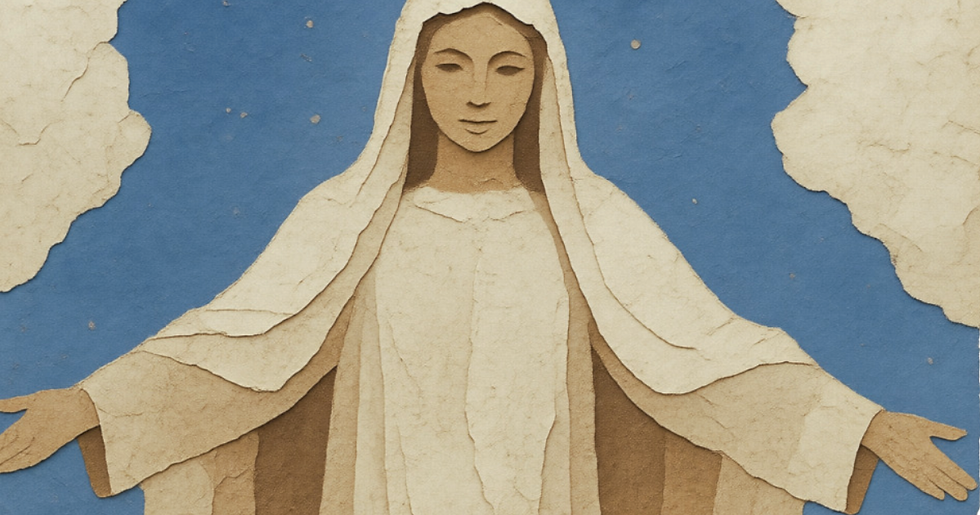
"I looked over towards this chapel whence so much light shone, and above the altar was a living figure, tall, majestic, beautiful and full of mercy. It was the Most Holy Virgin Mary, resembling her figure on the Miraculous Medal. At this sight I fell on my knees right where I stood."
"An irresistible force drew me towards her. She motioned to me to kneel down, and when I did so, she seemed to approve."
"She didn't speak a word, but I understood her perfectly."
Like Knock, Our Lady did not speak at Sant'Andrea delle Fratte. She said nothing. But Alphonse understood everything. In a single instant, without a word, without a catechism class, without a single argument, he understood the Catholic faith. He understood the reality of sin. He understood the mercy of God. He understood who he was and who she was and who her Son was. Everything he had spent his life rejecting became, in one blinding moment, the only truth that mattered.
He would later write:
"In becoming a Catholic, I sacrifice all my interests and all my hopes I have on earth; and yet I am not mad. Everyone knows that I am not mad, that I have never been mad. Surely they must receive my testimony."
The Heart of Her Message
Eleven days later, on January 31, 1842, Alphonse Ratisbonne was baptized at the Church of the Gesù in Rome. He took the name Marie-Alphonse. He received Confirmation and his first Holy Communion on the same day. His conversion sent shockwaves through Roman society.
Pope Gregory XVI ordered a thorough investigation, which was completed in a matter of weeks. The Vicar General of Rome, Cardinal Patrizi, declared the conversion miraculous on June 3, 1842. A plaque was placed in the chapel at Sant'Andrea delle Fratte that reads to this day:
"On January 20, 1842, Alphonse Ratisbonne of Strasbourg came here as an obstinate Jew. The Virgin appeared to him as you see her. He fell down as a Jew and got up as a Christian. Visitor, take back with you the precious memory of the mercy of God and of the power of the Most Holy Virgin."
Alphonse's family disowned him. His fortune was revoked. His engagement was broken. He lost everything the world had given him, and he did not hesitate. He entered the Society of Jesus and was ordained a priest in 1847. He reconciled with his brother Théodore, the very conversion that had once filled him with rage.
Together, the two brothers founded the Congregation of Our Lady of Sion, dedicated to prayer and service. Alphonse moved to Jerusalem in 1855, where he purchased the ruins of the Praetorium of Pontius Pilate and built the Sanctuary of the Ecce Homo. He established convents, schools, and orphanages, and spent the remaining thirty years of his life in the Holy Land serving God. He died in Ein Karem, near Jerusalem, on May 6, 1884.
Among the saints who later prayed at the altar where Our Lady appeared to Alphonse were St. John Bosco, St. Thérèse of Lisieux, and St. Maximilian Kolbe. Kolbe, who would give his life at Auschwitz, chose to celebrate his very first Mass at that altar in 1918. The story of Ratisbonne's conversion was one of the sparks that ignited Kolbe's lifelong mission to spread devotion to the Immaculate.
Our Lady of Zion teaches us something we might be tempted to forget. No heart is too hard. No mind is too closed. No hostility is too deep. A man who mocked the medal, who despised the Church, who wore the image of the Immaculate around his neck as a joke, was brought to his knees by a single silent glance from the Mother of God.
She did not argue with him. She did not debate him. She did not wait for him to be ready. She simply appeared, full of mercy and beauty and light, and he understood. Everything. All at once. Without a single word.
And what prepared the way? Small things. A medal accepted as a joke. A prayer recited to win a dare. And a handful of friends who would not stop praying for him, one of whom gave his life for that intention without ever seeing the result.
That is how Our Lady works. Through small gestures. Through persistent prayers. Through people who love someone enough to keep asking heaven for their conversion even when it seems impossible.
Nothing is impossible for her. Alphonse Ratisbonne is the proof.
Sources and Further Reading
The details of Alphonse Ratisbonne's conversion are drawn from his own sworn testimony given during the canonical investigation ordered by Pope Gregory XVI and conducted by the Vicariate of Rome in February 1842, from his autobiographical letters, and from the historical records maintained by the Basilica of Sant'Andrea delle Fratte. The miraculous conversion was formally declared on June 3, 1842 by Cardinal Patrizi, Vicar General of Pope Gregory XVI. All excerpts are from Ratisbonne's recorded testimony.
For those who want to go deeper:
Rome (Italy) 1842 · MaryPages
The Miraculous Conversion of Alphonse Ratisbonne · Voice of the Family
The Conversion of Alphonse Ratisbonne · Prof. Roberto de Mattei
January 20, 1842: The Conversion of Alphonse Ratisbonne · FAMVIN
Our Lady of Zion · The Miracle Hunter


Comments