
Our Lady of Šiluva

Updated: Jun 5
Šiluva, Lithuania · 1608

TLDR
She appeared weeping on a rock to Calvinist children in a town where the Catholic faith had been dead for eighty years, and spoke only one sentence: "There was a time when my beloved Son was worshipped here. Now they have given this sacred soil over to the plowman." A buried chest containing a painting of the Madonna, hidden for eighty years, was found exactly where she appeared, and the blind man who remembered burying it had his sight restored. The entire town returned to the Catholic faith, not because of an argument, but because of a Mother's tears.
Year | 1608 |
Location | Šiluva, Lithuania |
Visionary | Shepherd children |
Apparitions | 2+ |
Church Status | Papal decree by Pope Pius VI (1775) |
Key Message |
One sentence converted entire Calvinist town. |
The World She Entered
For eighty years, the Catholic faith in Šiluva had been buried.
Lithuania was the last country in Europe to convert to Catholicism, embracing the faith in the fourteenth century. In Šiluva, a small town in the center of the country, a beautiful church had been built thanks to the generosity of the Giedgaudas family, who donated a treasured icon of the Madonna and Child, said to have been brought from Rome. The faithful gathered, the sacraments were celebrated, and for generations, the people of Šiluva knew Jesus Christ and honored His Mother.
Then the Reformation swept through Lithuania. In 1532, Protestant forces seized Catholic lands. By 1551, Calvinism had taken hold, and the Catholic church in Šiluva was demolished. The parish priest, Father Holubka, knowing what was coming, wrapped the church's treasured painting of the Madonna and Child, along with liturgical vestments, gold chalices, and legal documents proving that the land belonged to the Catholic Church, in a sealed ironclad chest. With the help of a young man, he buried the chest deep in the ground near a large rock.
Then the priest died. The young man grew old. And for eighty years, the faith in Šiluva disappeared. Children were raised as Calvinists. No one remembered the church. No one remembered the painting. No one remembered the chest buried beside the rock. The sacred ground where the Mother of God had once been honored was given over to plows and cattle.
Until the summer of 1608, when a group of children were playing near that rock and heard the sound of someone weeping.
To Whom She Appeared
They were shepherd children, tending their flocks in a field on the outskirts of the village, playing near a large rock at the edge of a wooded area. They were not Catholic. They had been raised in the Calvinist creed. They did not know who the woman was or why she was crying.
And yet she came to them. Because they were her children too.
How She Appeared
One by one, the children stopped playing and stood frozen, staring at the rock. In the silence, they could hear loud sobbing. And then they saw her.
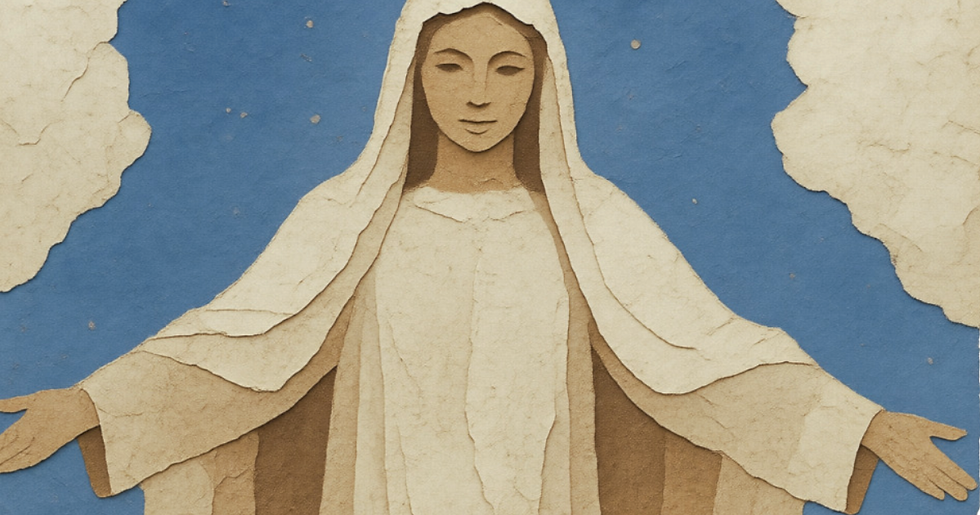
A beautiful young woman, dressed in flowing blue and white robes, standing on the rock, holding a baby in her arms. She was weeping bitterly. Her grief was so overwhelming, so raw, that tears ran down her cheeks and splashed on the stone beneath her feet.
She did not speak. She just wept. And then she disappeared.
The children ran home and told their parents and neighbors. Word spread through the village like fire. The next day, a crowd gathered at the rock, including a Calvinist pastor who came to investigate. And she appeared again, standing on the same rock, holding the same child, weeping the same tears.
This time, the Calvinist pastor saw her too. Everyone did. Catholics and Protestants, believers and skeptics, the faithful and the lapsed. She did not limit her apparition to one chosen soul. She came for all of them. And they all watched a Mother cry.
What She Said
The Calvinist pastor, shaken by what he was seeing, gathered his composure and asked the question: "Why are you weeping?"
And the woman answered, in a voice filled with sorrowful emotion:
"There was a time when my beloved Son was worshipped by my people on this very spot. But now they have given this sacred soil over to the plowman and the tiller and to the animals for grazing."
One sentence. And then she vanished.
The Heart of Her Message
Among those who heard about the apparition was a blind man from a nearby village, more than a hundred years old. When the story reached him, a memory stirred, something he had carried for eighty years. As a young man, he had helped Father Holubka bury an ironclad chest next to a large rock, the very rock where the weeping woman had appeared.
He was brought to the site. And there, near the rock where Our Lady had stood and wept, the people dug into the earth and found the chest, perfectly preserved after eight decades underground. Inside were the painting of the Madonna and Child, the liturgical vestments, the gold chalices, and the legal documents proving that this land had once belonged to the Catholic Church and to the Mother of God.
When the chest was opened, the blind man's sight was restored.
The painting. The proof. The miracle. Everything buried for eighty years, brought back to light by a Mother's tears.
What happened next was one of the most remarkable conversions in the history of the Church. The people of Šiluva, who had been Calvinist for three generations, began returning to the Catholic faith. Not a few. The entire town. And then the surrounding region. A community that had lost its faith recovered it, not because of an argument or a theological debate, but because a Mother stood on a rock and cried, and her tears were so real and so heartbroken that they could not be ignored.
The apparition was authenticated by a Papal Decree issued by Pope Pius VI on August 17, 1775. Pope Pius XI called Lithuania "Terra Mariana," the Land of Mary. Pope John Paul II visited the shrine in 1993. Pope Benedict XVI blessed new golden crowns for the miraculous image in 2006 and sent a special envoy for the four hundredth anniversary of the apparitions in 2008. The Basilica of the Birth of the Blessed Virgin Mary stands at the site today, and the rock on which Our Lady stood is preserved within a chapel.
Our Lady of Šiluva is invoked especially by those who have lost their faith and by those who pray for them, because she came to a place where the faith had been dead for eighty years and she brought it back to life with nothing but her tears and one sentence.
Her message is the shortest in this entire collection and perhaps the most devastating. She did not ask for a Rosary. She did not warn of chastisements. She did not give instructions or secrets or prophecies. She stood on the ground where her Son had once been worshipped and she wept because He was worshipped there no longer.
That is the grief of God expressed through the heart of a Mother. The sorrow is not political. It is not institutional. It is personal. My beloved Son was worshipped here. And now He is not. That is what breaks her heart. Not that a building was torn down. Not that a legal dispute was lost. That her Son was forgotten. That the people she loves stopped loving Him back.
And her tears were enough to change everything.
Sources and Further Reading
The details of the Šiluva apparition are drawn from the historical records preserved at the Basilica of the Birth of the Blessed Virgin Mary in Šiluva, and from the Papal Decree of Pope Pius VI authenticating the apparition (August 17, 1775). The apparition is also attested by Pope John Paul II (visit in 1993) and Pope Benedict XVI (blessing of crowns in 2006, special envoy in 2008). All excerpts of Our Lady's words are from the recorded tradition preserved at the shrine.
For those who want to go deeper:
Our Lady of Šiluva, Lithuania, 1608 · Divine Mysteries and Miracles
Šiluva, Lithuania · The Miracle Hunter
Our Lady of Šiluva · MaryPages


Comments