
The Virgin of the Poor

Banneux, Belgium · January 15 – March 2, 1933

TLDR
She appeared eight times to an eleven-year-old girl and spoke only ninety-one words total, identifying herself as "the Virgin of the Poor" and asking for a small chapel. She said, "Believe in me, I will believe in you," the most tender reciprocal promise in the history of Marian apparitions.
Year | 1933 |
Location | Banneux, Belgium |
Visionary | Mariette Beco |
Apparitions | 8 |
Church Status | Fully approved (1949) |
Key Message |
|
The World She Entered
Twelve days after her last apparition at Beauraing, Our Lady came again. This time, even closer to the edge.
It was the dead of winter in 1933. The Great Depression had left millions across Europe without work, without food, without hope. In Germany, the Nazi Party was days away from seizing power. The world was sliding toward a darkness that would consume tens of millions of lives. And in a remote hamlet in the Ardennes region of Belgium, a poor family of nine was huddled in a modest house at the edge of a pine forest, with no electricity and barely enough to eat.
If Beauraing was Our Lady's urgent call to pray before the storm, Banneux was her promise that even in the storm, she would not forget the ones the world forgets first: the poor, the sick, the suffering, the overlooked.
She did not go to Brussels or Paris or Rome. She went to a house with no lights, on a road with no name, to a girl no one was watching.
To Whom She Appeared
Mariette Beco was eleven years old, the eldest of seven children. Her family was poor in the way that leaves no room for pretense. Her father, Julien, was a laborer and a lapsed Catholic. Her mother was overwhelmed with the daily work of keeping a large family alive.
The children rarely attended Mass. The nearest church was over a mile away through swampy ground.
Mariette had almost no religious formation. She had recently found a rosary on the road, and though she didn't quite know what to do with it, she kept it. She was not devout and she was not looking for a vision. She was a country girl doing what country girls do, watching out the window on a cold January evening, waiting for her younger brother to come home.
And in the garden, standing in the dark, surrounded by light, was a Lady.
How She Appeared
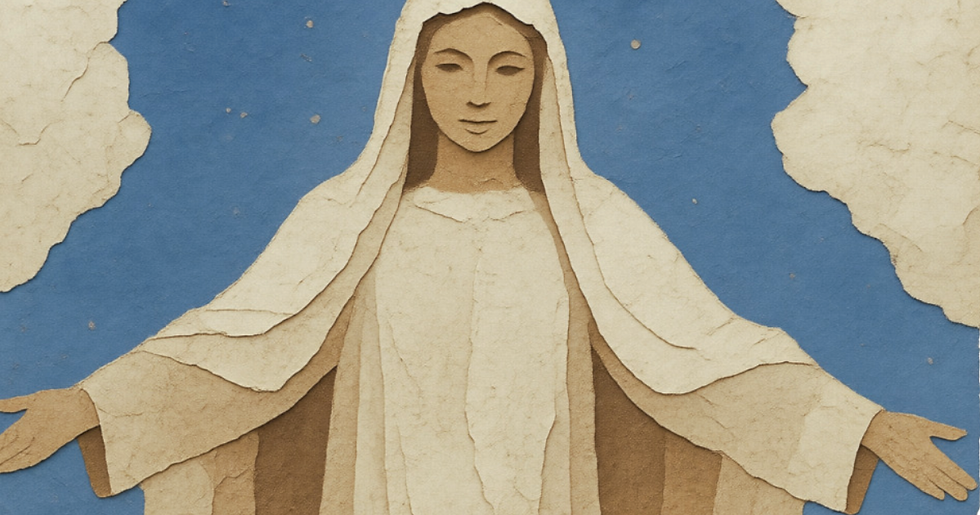
On Sunday evening, January 15, 1933, at about seven o'clock, Mariette pressed her face against the kitchen window, looking for her brother Julien. Instead, she saw a beautiful woman standing in the garden, glowing with light, wearing a long white gown with a blue sash, a transparent white veil, and a golden rose on her right foot. A rosary with a golden chain hung from her right arm, and her hands were joined in prayer.
Mariette called to her mother: "There is a lady in the garden. It is the Holy Virgin."
Her mother looked and saw a vague shape but dismissed it. She told Mariette not to go outside, afraid it might be a witch or a trick. Mariette stayed at the window, praying the rosary she had found, watching the Lady beckon to her with a gentle wave of her hand. After a few minutes, the Lady disappeared.
No one believed her. Her father scoffed. But three days later, on a bitterly cold Wednesday evening, Mariette went out into the garden and knelt in the snow to pray. The Lady came again. And this time, she spoke.
What She Said
Our Lady spoke only ninety-one words across all eight apparitions at Banneux. Every one of them matters.
On the second visit, she led Mariette through the dark to a small stream near the road. Kneeling beside the water, Mariette heard her say:
"Push your hands into the water. This spring is reserved for me."
The next evening, January 19, Mariette asked the question her heart had been holding:
"Who are you, beautiful Lady?"
"I am the Virgin of the Poor."
Of all the titles she could have chosen, she chose this one. Not the Queen of Heaven. Not the Immaculate Conception. The Virgin of the Poor. She identified herself not with power or majesty but with the ones who have the least.
She led Mariette to the spring again, and when the girl asked why the spring was reserved for her, thinking perhaps it was a personal gift, Our Lady smiled and corrected her gently:
"This spring is reserved for all nations, to relieve the sick."
And then she added something no child expects to hear from the Queen of Heaven:
"I will pray for you. Goodbye."
On the fourth visit, January 20, she made a simple request:
"I would like a small chapel."
Not a basilica. Not a grand shrine. A small chapel. For the poor.
On February 11, the feast of Our Lady of Lourdes, she returned and spoke three words that reach across every century and every border:
"I come to relieve suffering."
When the village chaplain asked for a sign that the apparitions were authentic, Mariette brought the request to Our Lady. Her answer was unlike anything heaven had given at any other apparition:
"Believe in me, I will believe in you."
And then, more gently:
"Pray much."
On February 20, she came again in the bitter cold:
"My dear child, pray much."
And on March 2, the last evening, during a torrential rain, the Lady came one final time. She revealed who she truly was, spoken with a seriousness that Mariette never forgot:
"I am the Mother of the Savior, Mother of God. Pray much."
She placed her hands on Mariette and blessed her. Then she said farewell and was gone.
The Heart of Her Message
She called herself the Virgin of the Poor, and in doing so she revealed something about the heart of God that the comfortable and the powerful often miss. God is closest to the ones who have the least. His Mother comes first to the forgotten, the struggling, the sick, the ones the world walks past without noticing. She did not come to Banneux despite its poverty. She came because of it.
Her spring was not for one girl or one village or one nation. It was for all nations, to relieve the sick. Her chapel was not meant to be grand. It was meant to be a place where the poor could come and know they are seen.
And her extraordinary promise, "Believe in me, I will believe in you," turns the whole relationship between heaven and earth on its head. She is not demanding faith as a prerequisite. She is offering a mutual trust, a covenant of love between a Mother and her children. You believe in me, and I will believe in you. I will trust you with my message. I will trust you to carry it.
Mariette Beco, after the apparitions, returned to her ordinary life. She did not seek attention, did not write books, did not become a public figure. She married and raised a family. She carried the memory of those eight winter evenings quietly for the rest of her life and died on December 28, 2011, at the age of ninety.
The apparitions were officially approved by the Bishop of Liège on August 22, 1949. Pope John Paul II visited the shrine on May 21, 1985, and said: "Today, the poor, and there are many forms of poverty, feel at home in Banneux. The poor come here seeking consolation, courage, hope, and union with God during their trials."
The spring still flows. The small chapel still stands. And the Virgin of the Poor is still waiting there for anyone who comes with an empty heart and open hands, ready to be filled.
Sources and Further Reading
The details of the Banneux apparitions are drawn from the testimony of Mariette Beco as recorded during the canonical investigation conducted by the Diocese of Liège (1935-1949), and from the historical documentation maintained by the Sanctuary of Banneux Notre-Dame. All excerpts of Our Lady's words are from Mariette's recorded testimony. The apparitions were formally approved on August 22, 1949.
For those who want to go deeper:
The Apparitions (1933) · Sanctuary of Banneux Notre-Dame (Official)
The Marian Apparition That Saved the Forgotten Ones · National Catholic Register
Mary's Message for Belgium: Beauraing and Banneux · Catholic Exchange
Banneux (Belgium) 1933 · MaryPages


Comments